
Journal of Education, Humanities, and Social Science Studies
Journal DOI: 10.15580/jehsss
Volume 1(1), pp. 38-50, 2026
Copyright ©2026, Creative Commons Attribution 4.0 International. https://jehsss.greenfieldjournals.org/
|
Journal of Education, Humanities, and Social Science Studies Journal DOI: 10.15580/jehsss Volume 1(1), pp. 38-50, 2026 Copyright ©2026, Creative Commons Attribution 4.0 International. https://jehsss.greenfieldjournals.org/
|
Addressing Institutional Challenges through Integrated Management Theories: A Case Study of the University of Nairobi
Salome Ndemi Mullei
Department of Postgraduate Studies in Education, Catholic University of Eastern Africa (CUEA). https://orcid.org/0009-0009-3478-8872
|
ABSTRACT |
|||
|
This paper examines how institutional challenges in higher education can be addressed through integrated management theories, using the University of Nairobi as a case study. A qualitative, conceptual approach based on secondary data and theory-driven analysis is adopted (UNESCO, 2023; World Bank, 2022). The findings indicate that financial constraints, mass enrolment, governance complexity, technological change, and human resource pressures are interconnected rather than isolated. The study shows that integrating Chaos Theory, Systems Theory, Total Quality Management (TQM), Kotter’s 8-Step Change Model, and the Kübler-Ross Change Curve enables more adaptive, coordinated, and context-responsive management. It concludes that no single theoretical framework is sufficient for managing complexity. The paper recommends strengthening adaptive leadership, integrating change management practices, enhancing institutional coordination, and aligning policy frameworks to support sustainable institutional performance.
|
|||
|
ARTICLE’S INFO |
|||
|
Article No.: 060626056 Type: Research DOI: 10.15580/jehsss.2026.1.060626056
Accepted: 29/06/2026 Published: 08/07/2026
|
*Corresponding Author
Salome Ndemi Mullei
E-mail: smmullei@gmail.com
|
Keywords: Higher education, institutional challenges, change management, systems theory, chaos theory, total quality management, Kotter’s 8-Step change model, Kübler-Ross Change Curve
|
|
|
|
|
|
|
1.0 INTRODUCTION
Higher education institutions in Kenya operate within increasingly dynamic and uncertain environments often shaped by policy reforms, technological change, and rising societal expectations. Over the past decade, the sector has expanded significantly in response to growing demand for university education and the need to support national development through human capital formation. Within this context, the University of Nairobi (UoN) remains a central institution with a strong mandate in teaching, research, and public engagement. This position, however, also places the university under considerable pressure to respond effectively to a range of operational and strategic challenges.
These challenges are neither isolated nor stable. Financial constraints, rapid technological shifts, increasing student enrolment, and heightened accountability requirements have combined to create a more complex institutional environment. Such pressures are particularly pronounced in public universities, where dependence on government funding is coupled with expectations for efficiency, quality, and global competitiveness (World Bank, 2022). At the UoN, these dynamics are further shaped by institutional scale, governance complexity, and the need to balance expanded access with the maintenance of academic standards.
In this context, management approaches that rely primarily on stability, control, and linear planning are increasingly limited. Universities function as open systems influenced by interconnected internal and external factors, requiring leadership approaches that are adaptive, integrative, and responsive to ongoing change (Stacey, 2022). This raises an important question: how can institutional leaders effectively manage such complexity while maintaining strategic direction and organizational coherence?
This paper addresses this question by examining how institutional challenges can be understood and managed through the integration of multiple management theories. Using the UoN as a case study, the study adopts a qualitative, conceptual approach based on secondary data and theory-driven analysis. It draws on Chaos Theory of Management, Systems Theory, Total Quality Management (TQM), Kotter’s 8-Step Change Model, and the Kübler-Ross Change Curve, and explores how these frameworks can be combined to inform institutional leadership.
The paper proceeds by outlining the theoretical and conceptual foundations, presenting the methodological approach, analysing the institutional context and key challenges, applying the selected theories, and critically reflecting on their combined use. In doing so, it contributes to ongoing discussions on higher education leadership by demonstrating how integrated theoretical perspectives can inform practice, policy, and future research in complex institutional environments (Sele & Mukundi, 2024).
2.0 METHODOLOGY
This study adopts a qualitative, conceptual research design grounded in a case study approach. The focus is on examining how institutional challenges in higher education can be addressed through the integration of management theories, using the University of Nairobi (UON) as an illustrative case. Rather than testing hypotheses, the study seeks to interpret and analyse existing conditions and theoretical perspectives in order to develop a coherent understanding of institutional management in complex environments. The research is interpretive in orientation, recognising that organizational challenges and responses are shaped by context, institutional history, and stakeholder dynamics. This approach is appropriate for exploring higher education systems, where change processes are often non-linear and influenced by multiple interacting factors (By, 2021; Stacey, 2022).
2.2 Data Sources
The analysis is based on secondary data drawn from peer-reviewed academic literature, policy documents, institutional reports, and publications from international organizations such as UNESCO and the World Bank. These sources provide insight into both theoretical developments and the current state of higher education systems, particularly in the African context (UNESCO, 2023; World Bank, 2022). For this study, secondary data is appropriate because it allows for the synthesis of existing knowledge across different domains, including management theory, higher education policy, and institutional practice. It also supports a broader perspective on systemic challenges that may not be fully captured through single-site empirical data.
2.3 Analysis
The study employs a theory-driven analytical approach. Consequently, five management frameworks Chaos Theory of Management, Systems Theory, Total Quality Management (TQM), Kotter’s 8-Step Change Model, and the Kübler-Ross Change Curve are used as interpretive lenses to examine institutional challenges. The analysis captures three stages. First, key institutional challenges are identified based on the literature and sector reports. Second, each theoretical framework is examined in terms of its core assumptions and relevance to higher education contexts. Third, the theories are applied in an integrated manner to demonstrate how they can collectively inform institutional management. This integrative approach reflects the understanding that complex organizational problems cannot be adequately addressed through a single theoretical perspective (Sele & Feh, 2026). Instead, combining multiple frameworks allows for a more comprehensive analysis that captures structural, strategic, and human dimensions of institutional change (Cameron & Green, 2022; Meadows, 2022).
2.4 Limitations of the study
Despite the fact that this paper offers a theoretically grounded analysis of institutional challenges in higher education, several limitations should be noted. First, the study relies on secondary data and conceptual analysis rather than primary empirical evidence. Although existing literature and sector reports provide useful insights, they may not fully reflect the everyday experiences of staff and students within the institution. Empirical methods such as interviews or case-based observations would offer deeper understanding of how management theories are applied in practice (By, 2021). Second, the focus on a single case, the UoN) limits the broader applicability of the findings. Institutional contexts differ across regions, particularly in terms of governance structures, funding models, and policy environments, which may affect how relevant the conclusions are beyond this setting (UNESCO, 2023). Third, the integration of multiple theoretical frameworks strengthens the analysis but makes it difficult to assess the specific contribution of each theory. The relationships between the frameworks are discussed conceptually, without empirical validation (Cameron & Green, 2022). Finally, the higher education landscape continues to evolve, meaning that some issues identified may shift over time (World Bank, 2022). Consequently, these limitations signal the need for further empirical and comparative research over a period of time to establish trends necessary for institutional relevance and situational leadership.
This study adopts a multi-theoretical perspective to examine how institutional challenges in higher education can be addressed by institutional heads through integrated management theories. Higher education institutions increasingly operate in environments shaped by structural constraints, policy demands, and human dynamics. These conditions require approaches that move beyond single-theory explanations. Accordingly, this paper draws on Chaos Theory of Management, Systems Theory, Total Quality Management (TQM), Kotter’s 8-Step Change Model, and the Kübler-Ross Change Curve. Each framework offers a different lens for understanding organizational behaviour, leadership, and change, and together they provide a more comprehensive basis for analysis. Therefore, this section critically examines the historical foundations, key proponents, and limitations of each theory, while establishing their relevance to institutional leadership in higher education.
3.1 Chaos Theory of Management
Chaos Theory of Management has its origins in the natural sciences, particularly in the work of Edward Lorenz in the 1960s. His work on sensitivity to initial conditions—often referred to as the “butterfly effect”—challenged assumptions that complex systems could be predicted and controlled with precision. Small changes in starting conditions could produce significantly different outcomes, highlighting the limits of linear thinking.
In organizational contexts, scholars such as Ralph Stacey have extended these ideas to argue that organizations function as complex adaptive systems shaped by nonlinear interactions and continuous change (Stacey, 2022). From this perspective, outcomes are not always the result of deliberate planning but rather often come from the interaction of multiple factors over time. Within higher education, this perspective is useful in understanding why institutional environments are often unpredictable. Policy shifts, funding changes, and technological developments can generate compounded effects across multiple areas of an institution. However, despite its explanatory strength, chaos theory offers limited practical guidance for decision-making. As argued by (2021), an overemphasis on unpredictability creates uncertainty in management practice if not complemented by more structured approaches. As a result, Chaos Theory of Management is most effective when used alongside frameworks that provide clearer direction for action.
Systems theory, developed by Ludwig von Bertalanffy, provides a holistic approach to understanding organizations as interconnected systems rather than isolated parts. It emphasizes that organization effectiveness depends on how well its different components interact. Scholars such as Peter Senge and Donella Meadows further developed systems thinking by highlighting feedback loops, interdependencies, and the importance of organizational learning (Meadows, 2022).
In higher education, this perspective remains valuable in explaining how institutional challenges are linked. For example, financial constraints can affect staffing levels, which in turn influence teaching quality and student outcomes. Similarly, changes in enrolment can impact infrastructure, administrative systems, and academic delivery. Therefore, Systems theory helps to explain why addressing one issue in isolation often fails to produce lasting results. Despite these strengths, systems theory has been criticized for its practical applicability. This is because its broad and abstract nature can make it challenging to identify clear priorities or actionable strategies (Sele Media Africa, 2026). Additionally, critics have pointed out that it may not fully account for power dynamics and institutional politics, which influence decision-making processes (By, 2021). Despite this, the systems theory remains a useful framework for understanding organizational interdependence and the importance for coordinated interventions.
3.3 Total Quality Management (TQM)
Total Quality Management (TQM) emerged from the work of W. Edwards Deming, Joseph Juran, and Philip Crosby, who underscored continuous improvement, process control, and quality assurance in organizational performance. Although TQM was initially applied in industrial settings, it has been adapted to education, where it focuses on improving teaching, learning, and administrative processes. In higher education, Edward Sallis, a key proponent of TQM, frames quality as a continuous and institution-wide responsibility involving all stakeholders (Sallis, 2021). Consequently, this promotes systematic evaluation, feedback mechanisms, and alignment between institutional processes and stakeholder expectations.
TQM is particularly relevant in contexts where institutions are under pressure to maintain standards while expanding access. It provides tools such as curriculum review, performance monitoring, and stakeholder engagement that support ongoing improvement.
Despite this, TQM has also been critiqued for the risk of becoming overly bureaucratic and focused on compliance and documentation over meaningful improvement. In fact, UNESCO (2023) argues that excessive standardization can limit innovation and reduce institutional flexibility. Also, the application of “customer” concepts in education remains contested, as universities serve broader societal and intellectual purposes beyond immediate satisfaction. Despite these limitations, TQM remains valuable when applied with flexibility and context appropriateness.
3.4 Kotter’s 8-Step Change Model
Kotter’s 8-Step Change Model provides a structured framework for managing organizational change. Developed by John Kotter and influenced by earlier work on change management, the model outlines key stages including creating urgency, building coalitions, developing vision, and embedding change in organizational culture (Kotter, 2021). The model is widely used because it offers practical direction for implementing change management initiatives. In higher education, where reforms often involve multiple stakeholders and competing priorities, it provides a clear framework for organizing and sustaining change processes. However, the model has been criticized for its linear and prescriptive nature. In fact, organizational change is not a linear process as it involves iteration, feedback, and adaptation to contexts of operation. By (2021) argues that rigid application of step-based models may reduce flexibility in complex environments. This limitation suggests that while Kotter’s framework is useful for providing structure, it should be used together with more adaptive approaches that provide adaptive management opportunities as conditions evolve.
The Kübler-Ross Change Curve, originally developed by Elisabeth Kübler-Ross in the context of grief, has been adapted to organizational settings to explain how individuals respond to change as discussed by Sele, J. P., & Feh, T. N. (2026) in their research, “Fragmented Minds, Fragile Foundations: Dissociation as Conceptual Disruption in Psychology”, the model identifies stages such as denial, anger, bargaining, depression, and acceptance, reflecting how individuals react to significant transitions. In management contexts, the model has been further developed by scholars such as Cameron and Green, who emphasize that emotional responses are significant in how individuals engage or interact with change (Cameron & Green, 2022). This perspective highlights that resistance is often occasioned by uncertainty, fear, or perceived loss, rather than purely rational considerations.
In higher education, understanding these emotional dynamics is important for managing change effectively. Consequently, leaders must recognize that responses to change vary across individuals and contexts, and that support mechanisms are necessary to facilitate effective transition. This model has been critiqued for assuming a linear progression through emotional stages. In practice, individuals may experience multiple responses simultaneously or move between stages at no single order. Despite this limitation, the model remains useful in drawing significant attention to the human dimension of change, which has often been overlooked in many technical frameworks (Sele & Zongo, 2025).
3.6 Analysis of Theoretical Framework
It is no doubt that each of the theories discussed above provide valuable insights into diverse aspects of organizational management critical for consideration by the head of an institution. Chaos theory highlights the need for adaptability in uncertain environments; systems theory emphasizes interdependence and alignment; TQM focuses on continuous improvement; Kotter’s model provides structure for change; and the Kübler-Ross curve addresses emotional responses to change. As evidenced, each framework has limitations when applied independently. Chaos theory lacks clear guidance for action, systems theory can be difficult to operationalize, TQM may become overly procedural, Kotter’s model may oversimplify change, and the Kübler-Ross curve may not fully capture the complexity of human behaviour and reactions to change. Consequently, for a more balanced and comprehensive approach, these frameworks need to be integrated. This is because their integration allows for an all-inclusive approach of dealing with structural, strategic, and human dimensions of institutional challenges. This combined perspective forms the foundation for the analysis that follows, demonstrating how integrated management theories can be applied by the head of an institution to address challenges in higher education.
3.7 Conceptual Framework
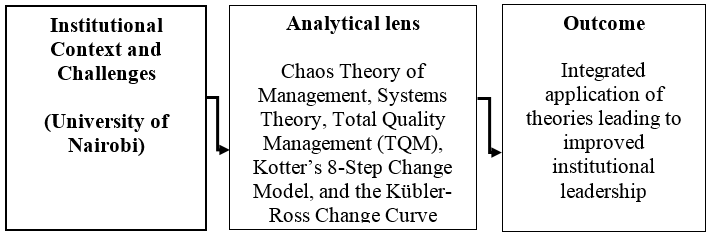
The conceptual framework is structured in three levels. The first level represents the institutional context and challenges. The second level presents the management theories, where Chaos Theory, Systems Theory, TQM, Kotter’s Model, and the Kübler-Ross Curve interact as complementary approaches in addressing challenges arising from the institutional context. The final level depicts institutional outcomes resulting from integrated application of the theories to address contextual challenges and this leads to improved institutional leadership characterized by improved quality, effective change management, enhanced coordination, and institutional sustainability. The arrows between the levels indicate the dynamic relationships which are critical for continuous adaptation as required in dynamic contexts of institutional operation.
3.8 Change management in higher education
Change is a constant feature of contemporary higher education, shaped by evolving policy frameworks, technological developments, and shifting expectations from governments and society. Universities increasingly operate in environments where adaptation is continuous rather than infrequent, requiring approaches that respond to both planned reforms and emerging pressures (UNESCO, 2023; World Bank, 2022).
Change also varies in scope, with incremental adjustments such as improvements in administrative processes happening alongside more transformative shifts, including the restructuring of institutional systems. These different forms of change require responses that combine structured planning with the ability to adapt as conditions evolve (Cameron & Green, 2022). Equally important is the human dimension, as institutional reforms affect established roles and practices and may be experienced differently across staff. Responses such as uncertainty or resistance are therefore part of the change process rather than obstacles alone. Taken together, these considerations suggest that effective change management in higher education depends on balancing structured approaches, such as Kotter’s model, with adaptive perspectives drawn from systems thinking and chaos theory to address complexity and uncertainty (Stacey, 2022; Meadows, 2022).
The University of Nairobi (UoN) operates within a higher education environment shaped by evolving economic conditions, policy reforms, and institutional demands. As one of Kenya’s oldest and most established public universities, it plays a significant role in teaching, research, and public service. Its national prominence places it at the centre of efforts to expand access to higher education and contribute to socio-economic development through human capital. At the same time, it is worth noting that this university functions within a broader system which is influenced not only by national priorities but also reginal and global higher education trends (UNESCO, 2023; World Bank, 2022). Understanding this context is important for situating institutional leadership within contemporary higher education realities. This is because institutional operations are not only shaped by internal structures but also by external forces such as funding models, regulatory frameworks, and technological developments. These elements interact in ways that influence how universities adapt and respond over time for relevance (Altbach & de Wit, 2021; UNESCO, 2023).
4.1 Historical positioning and role
Established in 1970, the university has developed into a comprehensive institution with multiple campuses and a wide range of academic programmes. Over time, it has contributed significantly to professional training, research, and policy engagement in Kenya. Its historical role has helped shape its identity as a leading institution within the region. Universities with such longstanding roles are often expected to balance multiple functions, including expanding access, maintaining academic standards, and supporting national development. These expectations influence institutional priorities and strategic direction (Altbach & de Wit, 2021). In fact, the institution can be understood as comprising academic, administrative, and financial components. Consequently, the effectiveness of the institution depends on the alignment of these components, particularly in contexts where resources must be carefully allocated (Meadows, 2022).
4.2 Governance structure and complexity
The governance structure of public universities like UoN typically includes councils, senates, and executive leadership, supported by colleges, departments, faculties, and administrative units. These structures provide a framework that enhances accountability, coordination, and specialization within the institution. Despite this, having multiple governance layers reflects the complexity of managing large organizations because decision-making often requires coordination across units with differing priorities and responsibilities. This thinking aligns with what systems theorists describe as a loosely coupled system, where units retain autonomy while remaining interdependent (Meadows, 2022; Senge, 2021). Such structures can support innovation and flexibility at the unit level, while also requiring mechanisms to ensure alignment with overall institutional goals and policies.
4.3 Expansion due to increased demand
One of the most defining features of UoN’s current context is the rapid expansion of student enrolment. Higher education systems globally, including in Kenya, have experienced significant growth in student enrolment because of increased demand for university education and policy efforts to widen access (World Bank, 2022; UNESCO, 2023). Massification reflects broader goals of improving access and developing human capital and also influences how institutions organize teaching, allocate resources, and plan for infrastructure development. Consequently, as enrolment grows, institutions such as UoN are required to adapt their systems and practices to accommodate changing needs. Rather than being viewed solely as a constraint, expansion can also be appreciated as part of a broader transformation in higher education, requiring institutions to adjust their structures and delivery models.
4.4 Financial and resource environment
The financial environment of public universities is shaped by government funding models, economic conditions, and policy decisions (Republic of Kenya, 2024). Institutions operate within resource frameworks that require careful prioritization and efficient allocation.
In response to these conditions, universities such as UoN are increasingly explore additional revenue streams such as partnerships, consultancy services, and professional programmes. These efforts reflect broader trends toward diversification of funding sources in higher education (World Bank, 2022). Consequently, financial considerations are closely linked to other institutional functions, including staffing, infrastructure, and programme delivery. This interconnectedness highlights the importance of coordinated planning and resource management (Meadows, 2022).
4.5 Policy and regulatory environment
UoN operates within a dynamic policy environment shaped by national education reforms and regulatory oversight. Higher education institutions operate within policy and regulatory frameworks that shape their structure and operations. Reforms in areas such as funding, quality assurance, and curriculum development influence institutional priorities and practices (Omariba & Barasa, 2024). These frameworks are designed to improve quality, relevance, and accountability within the sector. In addition, they require institutions to remain responsive to changing expectations and regulatory requirements. This creates an environment where leadership must balance compliance with the need for institutional flexibility and innovation (UNESCO, 2023).
4.6 Technological transformation and digitalization
Technological change has become a defining feature of higher education globally. The expansion of digital learning platforms, online delivery models, administrative technologies and Artificial Intelligence (AI) is reshaping how institutions operate (UNESCO, 2023). These technological changes influence UoN’s teaching methods, assessment practices, and administrative systems. It also requires investment in infrastructure, staff training, and institutional support mechanisms. Importantly, technological transformation involves not only technical changes but also shifts in organizational practices and culture. Adapting to these changes requires coordinated efforts across institutional units and alignment with broader strategic goals as well as Kenya’s relevant policy frameworks.
4.7 Human resource dynamics and organizational culture
Human resources are a critical determinant of institutional performance at UoN because these resources are central to the functioning of higher education institutions. Academic and administrative staff contribute to teaching, research, and institutional management, while also shaping organizational culture. Organizational culture plays a significant role in how institutions respond and adapt to change. Environments that encourage collaboration, learning, and innovation are more likely to support adaptation, while those that prioritize stability may respond more cautiously (Senge, 2021). Leadership is therefore important in fostering conditions that support engagement, professional development, and institutional responsiveness.
4.8 Stakeholder environment
UoN like any other higher education institutions in their operations need to remain is accountable to a wide range of stakeholders, including government agencies, students, parents, employers, and international partners. These stakeholders have diverse and often conflicting expectations, such as affordable access, high-quality education, employable graduates, and impactful research. Balancing these expectations presents a significant challenge for institutional leadership because decisions that satisfy one group may create tensions with others. Consequently, this requires institutions to balance competing demands and align their activities with broader goals (World Bank, 2022). This also needs institutions to navigate trade-offs while aligning their goals with broader societal needs.
4.9 Summary of institutional context
The institutional context of the UoN is characterized by interconnected structural, financial, policy, technological, and human factors. These elements influence how institutions operate and adapt within changing environments (UNESCO, 2023). Recognizing these interdependencies is important as it provides a foundation for understanding institutional dynamics and informs the development of appropriate management responses. In addition, it highlights the importance of approaches that consider the broader system within which institutions function.
5.0 Key challenges based on institutional context
The institutional environment outlined in the preceding section gives rise to a set of interrelated challenges that shape how the UoN is led and managed. This is because UoN operates within a higher education system undergoing rapid change, where financial, policy, technological, and organizational pressures intersect. These pressures are reflected in a set of current and observable challenges that affect institutional functioning. Rather than isolated issues, they represent interconnected conditions that shape how the university operates within Kenya’s evolving higher education landscape (UNESCO, 2023; World Bank, 2022). This section discusses key challenges that a head of institution, in this case UoN, should understand as they could negatively affect the achievement of institutional goals and objectives.
5.1 Financial constraints and instability
One of the most visible challenges facing the UoN relates to financial constraints. Public universities in Kenya have experienced changes in funding models, including the shift toward differentiated unit cost funding and student-centered financing. These reforms have affected the predictability and adequacy of government allocations (Republic of Kenya, 2024).
At the same time, operational costs particularly staff salaries, infrastructure maintenance, and digital investments continue to rise. This creates a gap between available resources and institutional needs. Reports on Kenya’s higher education sector indicate that many public universities are operating under financial strain, with implications for service delivery and institutional stability (World Bank, 2022). Within this context, financial pressure is not one-off but rather ongoing, shaping day-to-day operations as well as long-term planning.
5.2 Governance structures compromise decision making
The UoN operates under a governance framework defined by the Universities Act (2012) and subsequent policy reforms. While the governance structure of UoN is comprehensive, it presents coordination challenges due to the involvement of multiple decision-making bodies. As earlier mentioned, the governance structure of the UoN involves multiple layers, including the University Council, Senate, faculty and department-level bodies. While these structures support accountability, they also contribute to complex decision-making processes. In practice, this has resulted in delays in implementing reforms, approving programmes, or responding to emerging issues. The need to navigate formal procedures alongside informal institutional dynamics adds to this complexity. Such governance arrangements are typical of large public institutions, where coordination across units is necessary but not always efficient (Meadows, 2022).
5.3 Mass enrolment with limited capacity
The continued expansion of student enrolment remains a defining feature of the university. Increased access to higher education, supported by government policy, has led to growing student numbers without equivalent expansion in physical and academic infrastructure (UNESCO, 2023). At the UoN, this is reflected in high student-to-lecturer ratios, limited classroom space, and strain on laboratory and library facilities. These conditions affect how teaching and learning are organized and experienced. The issue is not simply enrolment growth itself, but the pace at which institutional capacity is able to adjust to that growth and whether students are deriving value for money.
5.4 Declining quality of education
Closely linked to massification is the challenge of maintaining academic quality. Concerns about academic quality and graduate outcomes continue to shape discussions within the higher education sector. Universities are increasingly expected to produce graduates who are not only academically qualified but also equipped with skills relevant to the labour market (Altbach & de Wit, 2021). At the UoN, the need to maintain academic standards while responding to changing professional and technological demands remains a continuing issue. Sector analyses point to gaps between university training and employer expectations, particularly in areas such as practical skills and digital competencies (World Bank, 2022). This places pressure on UoN to review curricula and teaching approaches within existing constraints.
5.5 Policy and regulatory environment
The UoN operates within a dynamic policy environment shaped by national education reforms and regulatory bodies such as the Commission for University Education (CUE). These policy reforms lead to ongoing changes in funding mechanisms, quality assurance frameworks, and curriculum approaches such as Competency Based Education system as well as alignment to Kenya’s National Education Sector Strategic Plan (NESSP) 2023-2027 and Vision 2030 (Omariba & Barasa, 2024). These policies place additional demands on on university staff to review curricula, upgrade teaching methodologies, and ensure compliance with regulatory standards while operating in unsupportive remuneration structures hence demotivating staff.
5.6 Technological transformation and digitalization
The global shift toward digital learning has significantly impacted higher education institutions, including UoN especially following global disruptions such as the COVID-19 pandemic. Consequently, efforts to expand online and blended learning have led to disparities in digital infrastructure and capacity (UNESCO, 2023). Challenges include inconsistent internet access, limited digital resources, and varying levels of digital literacy among staff and students. These factors affect how effectively digital systems including AI are integrated into teaching and administration. The issue extends beyond access to technology, encompassing how it is used within institutional practices especially where UoN and national policies are not instituted or adhered to.
5.7 Human Resource Dynamics
The effectiveness of the UoN is heavily dependent on its academic and administrative staff. However, the institution faces several human resource challenges, including staff shortages, aging faculty, limited professional development opportunities, and staff strikes due to delays in payments or honouring of payment agreements between the Government of Kenya and the staff union. In addition, resistance to change is also a significant issue, particularly in the context of digital transformation and curriculum reforms in alignment to Competency Based Education (CBE). On the overall, some of the UoN staff have perceived changes as threats to their established roles or competencies.
5.8 Lack of public accountability
As a leading public university, the UoN is subject to increasing scrutiny from diverse stakeholders and often falls short in terms of accountability. These include government agencies, students, employers, and the public. Expectations extend beyond academic performance to include issues such as graduate employability, research output, and efficient use of resources (World Bank, 2022). These expectations are not always aligned, creating pressure on the institution to balance competing demands. In addition, public visibility and accountability further intensify this pressure, particularly because higher education is closely linked to national development polices and goals.
5.9 Summary of institutional challenges
The myriad of challenges facing the UoN are closely interconnected and reflect broader trends within the higher education sector. Financial constraints influence staffing and infrastructure; enrolment expansion affects teaching conditions; governance structures shape responsiveness; technological gaps intersect with capacity; and policy reforms influence institutional priorities. Understanding these challenges as part of a wider system is important for analysing how institutions operate under changing conditions. This interconnectedness provides a basis for examining how integrated management theories can be applied by the head UoN in addressing these issues in a structured and contextually relevant manner (UNESCO, 2023).
6.0 Application of integrated management theories to University of Nairobi (UoN) challenges
The challenges facing the UoN are closely interconnected, and no single management framework is sufficient to address them in isolation. Financial pressures influence staffing and infrastructure; enrolment growth affects teaching conditions; governance structures shape decision-making; and technological change intersects with human capacity. In this context, the value lies not in selecting one theory over another, but in understanding how different perspectives can be combined to respond to these conditions in a coherent way (UNESCO, 2023). Consequently, this section demonstrates how Chaos Theory of Management, Systems Theory, Total Quality Management (TQM), Kotter’s 8-Step Change Model, and the Kübler-Ross Change Curve can be applied together by the head of institution, drawing on specific examples from the institutional context.
6.1 Dealing with financial constraints
Financial uncertainty at the University of Nairobi reflects broader changes in the funding of public universities in Kenya. Shifts in government allocation models have made funding less predictable, while operational costs continue to increase (Republic of Kenya, 2024). These pressures are visible in areas such as delayed payments, constrained infrastructure development, and limitations in programme expansion.
What is evident in this situation is that financial challenges do not remain confined to budget lines. For example, delays in disbursement affect staffing decisions, which then influence teaching loads and the quality of interaction between lecturers and students. This interconnected effect is consistent with systems theory, which emphasizes that changes in one part of an organization are likely to influence others (Meadows, 2022). At the same time, the unpredictability of funding aligns with insights from chaos theory. Financial conditions cannot be treated as stable or linear, particularly where policy changes introduce new variables. The increasing reliance on alternative revenue streams—such as parallel degree programmes and externally funded research—illustrates how the institution is adjusting within an uncertain environment (World Bank, 2022). Maintaining academic standards under these conditions also draws attention to TQM principles, particularly the emphasis on continuous monitoring and improvement even when resources are constrained (Sallis, 2021).
6.2 Enrolment expansion and systems dependency
The growth in student enrolment at the UoN is closely linked to national efforts to expand access to higher education. However, the pace of this expansion has not always been matched by equivalent growth in infrastructure or staffing (UNESCO, 2023).
The effects are visible in large lecture classes, increased pressure on laboratory facilities, and higher demands on administrative services. These outcomes illustrate how enrolment is not an isolated variable but one that affects multiple institutional systems simultaneously. The Systems theory provides a useful way of understanding these dynamics. Decisions related to student intake have implications for teaching capacity, space utilization, and student support services. Addressing enrolment therefore requires attention to how these elements interact, rather than focusing on numbers alone (Meadows, 2022). At the same time, TQM reinforces the need to monitor how these conditions affect the quality of teaching and learning. Feedback mechanisms, such as course evaluations and programme reviews, become important in identifying where expansion is affecting delivery (Sallis, 2021). Chaos theory adds a further dimension by highlighting that enrolment trends are not entirely predictable, particularly in contexts influenced by changing funding models and admission policies (Stacey, 2022).
6.3 Academic quality
Maintaining academic quality while responding to evolving labour market demands remains a central concern. At the UoN, efforts to revise curricula particularly in areas such as digital skills and interdisciplinary learning reflect ongoing attempts to align programmes with contemporary needs. TQM provides a structured way of approaching this process, emphasizing continuous review, stakeholder feedback, and incremental improvement (Sallis, 2021). However, curriculum reform is rarely a purely technical process. It often involves negotiation across departments, shifts in teaching practices, and adjustments in assessment methods. This is where Kotter’s 8-Step Model becomes relevant. Establishing the need for change, building support among academic staff, and embedding new approaches within institutional practice are all part of the process (Kotter, 2021). The human dimension of curriculum change is also significant. Staff responses may vary, particularly where reforms require new competencies or challenge established approaches. The Kübler-Ross Change Curve helps to explain these responses, highlighting stages such as uncertainty or resistance that may accompany institutional change (Cameron & Green, 2022).
6.4 Governance and coordination
The governance arrangements at the UoN involve multiple decision-making bodies, each with defined roles. While this structure supports accountability, it also introduces complexity in coordination. For instance, introducing new academic programmes or revising policies often requires approval across several levels, which can extend timelines and affect responsiveness. Systems theory helps to explain this by highlighting the interdependence of institutional units and the need for coordination across them (Meadows, 2022). Kotter’s model provides a way of structuring change within such environments. Building consensus, developing a shared vision, and ensuring that changes are sustained across different levels of the institution are essential steps (Kotter, 2021). However, governance processes are not always linear. Informal dynamics, competing interests, and evolving priorities often influence outcomes. Chaos theory is useful here in recognizing that not all aspects of decision-making can be fully controlled or predicted (Stacey, 2022).
6.5 Digital and technological advancement
The expansion of digital learning at the UoN has accelerated in recent years, particularly with the adoption of online and blended delivery models. While this shift has created new opportunities, it has also exposed differences in digital access and capacity across the institution (UNESCO, 2023). Implementing digital systems involves more than introducing new technologies. It requires changes in teaching methods, assessment practices, and administrative processes. Kotter’s model provides a structured approach to managing such transitions, particularly in building support and embedding new practices (Kotter, 2021). At the same time, the Kübler-Ross model highlights the varied responses of staff and students to these changes. Some may adapt quickly, while others may experience uncertainty or resistance, particularly where digital skills are limited (Cameron & Green, 2022). Systems theory further emphasizes the need to integrate digital initiatives with existing institutional processes, ensuring that they are not implemented in isolation.
6.6 Human resource adaptations
Staffing conditions at the UoN particularly workload pressures and capacity constraints shape how institutional changes are experienced and implemented. These factors influence both academic delivery and administrative effectiveness. The Kübler-Ross Change Curve provides a useful lens for understanding how individuals respond to change. Reactions such as hesitation or resistance are often linked to uncertainty or perceived increases in workload (Cameron & Green, 2022). Kotter’s model complements this by outlining how change can be introduced in a structured way, including communication, engagement, and reinforcement of new practices (Kotter, 2021). Chaos theory adds a further dimension by recognizing that responses to change are not always predictable. This highlights the need for flexibility and ongoing adjustment in managing human resource issues (Stacey, 2022).
6.7 Policy adaptations
Policy reforms in Kenya’s higher education sector continue to shape institutional operations. Changes in funding mechanisms, quality assurance requirements, and curriculum frameworks require universities to adapt their structures and processes (Omariba & Barasa, 2024). Systems theory helps to explain how these external changes influence internal processes, including planning, reporting, and programme design. At the same time, chaos theory highlights the uncertainty that often accompanies policy shifts, particularly when implementation timelines are tight. Kotter’s model provides a structured approach to managing these adjustments, particularly in ensuring that changes are understood, implemented, and sustained within the institution.
Critical synthesis of management theories from the University of Nairobi example
The preceding sections outlined the institutional context, key challenges, and the application of selected management theories within the UoN. What becomes clearer at this stage is that these challenges ranging from financial constraints and enrolment pressures to governance complexity and technological change are not isolated matters. Rather, they are interconnected and require responses that combine structure, adaptability, and coordination. This reinforces the central argument of the paper: that the value of management theories lies not in their individual application, but in how they are integrated to address complex institutional realities.
Each of the selected frameworks contributes a distinct analytical lens. Chaos Theory of Management highlights uncertainty and non-linearity, drawing attention to the limits of prediction in dynamic environments (Stacey, 2022). Systems theory complements this by focusing on interdependence and the relationships between institutional components, emphasising alignment across functions (Meadows, 2022). Total Quality Management (TQM) introduces a process-oriented perspective centred on continuous improvement, while Kotter’s 8-Step Model provides a structured approach to implementing and sustaining change (Kotter, 2021). The Kübler-Ross Change Curve adds a critical human dimension, recognising that institutional change is experienced emotionally and unevenly across individuals (Cameron & Green, 2022).
Considered independently, however, each framework has limitations. Chaos theory offers insight into uncertainty but provides limited operational guidance. Systems theory explains relationships but may lack clarity on specific interventions. TQM supports consistency but can underplay the disruptive nature of large-scale change. Kotter’s model provides structure, yet its staged progression may not fully reflect the iterative nature of institutional processes. Similarly, the Kübler-Ross model explains human responses but does not address structural or strategic considerations. These limitations point to the need for a more integrated approach.
The application section illustrates how these theories intersect in practice. For example, addressing financial constraints at the University of Nairobi cannot rely solely on efficiency measures associated with TQM. Such responses must also account for system-wide implications (systems theory) and the unpredictability of funding environments (chaos theory). Likewise, institutional efforts toward digital transformation require not only structured implementation processes (Kotter) but also attention to how staff and students adapt to change (Kübler-Ross). These examples demonstrate that institutional challenges are best understood through multiple, overlapping perspectives.
A key insight emerging from this synthesis is the importance of balancing structure and flexibility. Over-reliance on structured models may limit responsiveness, while purely adaptive approaches may lack direction. Integrating these theories allows for a more balanced approach, where structured frameworks guide action and adaptive perspectives ensure responsiveness to changing conditions.
The discussion also underscores the role of context. The effectiveness of any management approach depends on how well it aligns with institutional realities. In the case of the UoN, factors such as resource constraints, governance arrangements, and policy dynamics shape how theoretical insights are applied. This supports the view that management theories should not be applied mechanically, but interpreted in relation to specific institutional conditions (UNESCO, 2023).
On the overall, the analysis suggests that contemporary higher education management benefits from combining, rather than choosing between, theoretical perspectives. Integration provides a better understanding of institutional challenges which supports more coherent and context-sensitive responses.
The analysis presented in the section above highlights that institutional challenges are best addressed through the combined use of multiple management perspectives. While this synthesis provides a conceptual basis for understanding complexity within higher education, it also raises an important practical question: How can these integrated insights be translated into actionable strategies within institutional settings? In contexts such as the University of Nairobi, where resource constraints, governance structures, and policy dynamics interact, there is a need to move beyond theoretical integration toward practical implementation. The recommendations below build on this synthesis by outlining ways in which integrated management approaches can be applied in practice, policy, and future research.
8.1 Recommendations for practice
At the institutional level, leadership at UoN must prioritize adaptive, integrated, and human-centered management practices that reflect the complexity of the university environment.
Firstly, there is a need to strengthen adaptive financial management strategies by diversifying revenue streams beyond government funding. In line with Chaos Theory, which emphasizes responsiveness to uncertainty, the university should expand income-generating initiatives such as executive education, online learning programs, and industry partnerships. This approach enhances institutional resilience and reduces vulnerability to financial shocks (Stacey, 2022).
Secondly, UoN should adopt a systems-based approach to institutional planning and coordination. The interconnected nature of challenges such as enrolment growth, infrastructure limitations, and staffing shortages necessitates integrated decision-making across departments. Implementing digital enterprise systems that link academic, administrative, and financial functions would improve efficiency, transparency, and data-driven decision-making. Systems Theory underscores that alignment among institutional components is essential for achieving organizational effectiveness (Meadows, 2022).
Thirdly, the university must institutionalize continuous quality improvement mechanisms grounded in TQM principles. This includes regular curriculum reviews, robust quality assurance processes, and active stakeholder engagement in program development. Emphasis should be placed on aligning academic programs with labour market needs to enhance graduate employability. However, these processes must remain flexible to avoid excessive bureaucratization and to support innovation (Sallis, 2021; UNESCO, 2023).
Fourthly, effective change management practices must be embedded within institutional operations. Applying Kotter’s 8-Step Change Model, leadership should ensure that all major reforms—such as digital transformation—are guided by clear vision, stakeholder engagement, and structured implementation processes. At the same time, attention must be given to the emotional and psychological responses of staff, as explained by the Kübler-Ross Change Curve. Providing training, open communication, and support systems will facilitate smoother transitions and reduce resistance to change (Cameron & Green, 2022; Kotter, 2021).
Finally, leadership capacity development is essential for sustaining these practices. Institutional leaders must be equipped with the skills to integrate multiple management theories and apply them contextually. This includes fostering participatory governance, promoting accountability, and strengthening evidence-based decision-making processes. Such leadership is critical for navigating complexity and driving sustainable institutional transformation (World Bank, 2022).
8.2 Recommendations for policy
At the policy level, there is a need for reforms that create an enabling environment for effective university management in Kenya as follows:
Firstly, the government should establish more predictable and sustainable funding frameworks for public universities. The current volatility in funding undermines institutional planning and performance. Policy reforms should therefore focus on diversified funding models that combine government support with performance-based allocations and incentives for innovation and research (Republic of Kenya, 2024).
Secondly, regulatory bodies such as the Commission for University Education should strengthen quality assurance frameworks while allowing flexibility for institutional innovation. Policies should encourage universities to adopt blended learning models, integrate digital technologies, and collaborate with industry partners. This aligns with TQM principles of continuous improvement and stakeholder responsiveness while supporting adaptability in a rapidly changing educational landscape (UNESCO, 2023).
Thirdly, national education policies should support capacity building in leadership and governance within higher education institutions. This includes training programs for university leaders in strategic management, change management, and digital transformation. Strengthening leadership capacity at the policy level ensures that institutions are better equipped to implement reforms effectively (World Bank, 2022). Additionally, policies should promote stronger collaboration between universities, industry, and international partners. Such partnerships can enhance resource mobilization, research output, and curriculum relevance. From a system strengthening perspective, these collaborations enhance linkages between higher education and the broader socio-economic environment, thereby improving institutional performance and national development outcomes.
8.3 Recommendations for future research
While this paper provides a theoretically grounded analysis of institutional challenges and management approaches at the University of Nairobi, further empirical research is needed to strengthen and validate these insights. In particular, future studies should examine how integrated management approaches operate in practice. This includes assessing how the combined use of chaos theory, systems thinking, and structured change models influences institutional performance, coordination, and resilience over time.
There is also a need for more context-specific research on digital transformation within Kenyan public universities. Understanding its effects on teaching quality, student outcomes, and institutional efficiency would provide practical insight into how digital strategies can be implemented more effectively in resource-constrained environments (UNESCO, 2023). Closely linked to this is the need to explore the human dimension of change. Building on the Kübler-Ross framework, future research should examine how academic and administrative staff experience institutional reforms, particularly in contexts where resistance to change affects implementation.
Comparative studies across public universities would further strengthen understanding by identifying patterns and contextually relevant practices that can be adapted across institutions facing similar challenges. In addition, interdisciplinary research that connects management theory with education policy, organizational behaviour, and technology studies would support the development of more integrated and context-sensitive frameworks for higher education management (By, 2021).
On the overall, future research should move beyond theoretical discussion toward empirical and comparative analysis. Such work would help refine integrated management approaches and provide stronger evidence to inform practice and policy in complex and evolving higher education environments.
This paper set out to examine how institutional challenges in higher education can be addressed through the integration of management theories, using the University of Nairobi as a case study. It was written in response to the need to better understand how institutional leaders can navigate increasingly complex and changing environments using established theoretical perspectives. Drawing on a qualitative, conceptual approach based on secondary data and theory-informed analysis, the study has shown that challenges related to finance, enrolment, governance, academic quality, technology, and policy are closely connected rather than separate issues. These conditions reflect wider developments across the sector and point to the limitations of addressing institutional problems in isolation (UNESCO, 2023; World Bank, 2022).
The analysis demonstrates that managing change in higher education extends beyond the introduction of new systems or reforms. Change unfolds over time and is shaped by uncertainty, institutional structures, and the responses of individuals within the organisation. In this context, no single management theory provides a sufficient basis for action. While Chaos Theory, Systems Theory, Total Quality Management (TQM), Kotter’s 8-Step Change Model, and the Kübler-Ross Change Curve each offer useful insights, their individual application provides only a partial understanding of institutional dynamics. When considered together, however, these frameworks offer a more comprehensive basis for action. They enable a balanced approach that combines structure with flexibility, coordination with adaptation, and strategic direction with attention to the human dimensions of change (Stacey, 2022; Meadows, 2022; Kotter, 2021; Sallis, 2021; Cameron & Green, 2022).
A key implication of this analysis is that effective institutional management depends on the ability to interpret and apply theory in context. Institutional realities such as resource constraints, governance arrangements, and policy environments shape how management approaches are implemented in practice. This is particularly relevant in public universities such as the University of Nairobi, where competing demands for access, quality, and financial sustainability must be managed simultaneously. The findings therefore reinforce the importance of approaches that not only theoretically informed but also practically adaptable to context.
At the same time, the study has limitations that should be acknowledged. It is based on secondary data and focuses on a single institutional case, and the integration of theories is examined at a conceptual level rather than through empirical testing. These constraints limit the extent to which the findings can be generalised and highlight the need for further empirical and comparative research (By, 2021; UNESCO, 2023).
On the overall, the paper highlights the importance of integrating multiple theoretical perspectives when addressing institutional challenges in higher education. Such an approach provides a more coherent and context-sensitive basis for decision-making and leadership. Future research should build on this work by examining how integrated management approaches are implemented in practice through empirical evidence and how they influence institutional performance and policy development over time.
References
Altbach, P. G., & de Wit, H. (2021). Postpandemic outlook for higher education: Challenges and opportunities. International Higher Education, 105, 3–5.
By, R. T. (2021). Organizational change management: A critical review. Journal of Change Management, 21(3), 1–24.
Cameron, E., & Green, M. (2022). Making sense of change management (6th ed.). Kogan Page.
Kotter, J. P. (2021). Leading change (updated ed.). Harvard Business Review Press.
Meadows, D. H. (2022). Thinking in systems: A primer (updated ed.). Chelsea Green Publishing.
Omariba, D., & Barasa, P. (2024). Higher education reforms and policy shifts in Kenya. African Journal of Education Policy, 8(1), 45–60.
Republic of Kenya. (2024). Education sector report 2024. Government Printer.
Sallis, E. (2021). Total quality management in education (4th ed.). Routledge.
Sele, J. P., & Feh, T. N. (2026). Fragmented Minds, Fragile Foundations: Dissociation as Conceptual Disruption in Psychology. African Journal of Stability and Development (AJSD), 18(1), 442–459. https://doi.org/10.53982/ajsd.2026.1801.21-j
Sele, JP; Zongo, PK (2025). Youth Unemployment and Its Impact on Nigeria's Socio-Economic Landscape. Greener Journal of Social Sciences, 15(1): 258-270, https://doi.org/10.15580/gjss.2025.1.082625131.
Sele, J. P., & Mukundi, M. B. (2024). The economics of climate change: Costs, benefits, and the transition to a green economy. Greener Journal of Social Sciences. https://doi.org/10.15580/gjss.2024.2.122024209
Sele Media Africa (April 18, 2026), Family Challenges JAMB’s Denial Over Alleged Kidnap Of Benue UTME Candidates, Sele Media Africa, https://selemedia.org/family-challenges-jambs-denial-over-alleged-kidnap-of-benue-utme-candidates/
Senge, P. M. (2021). The fifth discipline: The art and practice of the learning organization (Updated ed.). Crown Publishing.
Stacey, R. D. (2022). Strategic management and organisational dynamics (8th ed.). Pearson.
UNESCO. (2023). Higher education and sustainable development in Africa. UNESCO Publishing.
World Bank. (2022). Kenya education sector analysis. World Bank Group.
|
Cite this Article: Mullei, SN (2026). Addressing Institutional Challenges through Integrated Management Theories: A Case Study of the University of Nairobi. Journal of Education, Humanities, and Social Science Studies, 1(1): 38-50, https://doi.org/10.15580/jehsss.2026.1.060626056. |