
Journal of Education, Humanities, and Social Science Studies
Journal DOI: 10.15580/jehsss
Volume 1(1), pp. 51-69, 2026
Copyright ©2026, Creative Commons Attribution 4.0 International. https://jehsss.greenfieldjournals.org/
|
|
Journal of Education, Humanities, and Social Science Studies Journal DOI: 10.15580/jehsss Volume 1(1), pp. 51-69, 2026 Copyright ©2026, Creative Commons Attribution 4.0 International. https://jehsss.greenfieldjournals.org/
|
Post-Aid Peace: How Domestic Resource Mobilization Reduces Conflict Recurrence Better Than External Peacebuilding
John Philip Sele¹; Salome Ndemi Mullei²
¹ Department of Development Studies, Africa International University, Nairobi, Kenya — Founder & CEO, Sele Media Africa (selemedia.org) | Eagle Scholars Forge
² Catholic University of Eastern Africa (CUEA), Nairobi — Education in Emergencies Specialist; formerly Senior Technical Advisor for Education (CARE) and Senior Advisor, Education in Emergencies (World Vision International). ORCID: 0009-0009-3478-8872
|
ABSTRACT |
|||
|
For three decades the liberal peacebuilding orthodoxy has channelled billions of dollars of external assistance into post-conflict states on the assumption that foreign-funded statebuilding produces durable peace. The empirical record now contradicts that assumption. Drawing on a cross-national quantitative and qualitative analysis of four cases — Rwanda (1994–), Colombia (2016–), South Sudan (2011–), and Afghanistan (2002–2021) — this article argues that countries which built domestic tax capacity after conflict experience significantly lower recurrence than those which remained dependent on aid-driven statebuilding. The article introduces the concept of "fiscal social-contract depth" — the reciprocal relationship between taxation, public-service delivery, and citizen voice — and shows that it is the strongest statistical predictor of post-conflict stability among the variables examined. Rwanda, which raised tax-to-GDP from 10.5% in 2003 to 14.6% in FY 2023/24 and financed 59% of its budget from domestic sources, has recorded no large-scale recurrence since 1994. Colombia, despite high residual violence, has institutionalised a tax-and-peace linkage through the 2016 Final Agreement and its 2022 tax reform. South Sudan, where non-oil revenue is below 5% of GDP and ODA has averaged 23.8% of GDP since 2020, relapsed into civil war in 2013 and again in 2024. Afghanistan, where aid financed 75–80% of public expenditure before 2021, experienced an immediate fiscal and security collapse the moment external funding was withdrawn. The article draws on Political Settlement Theory (Kelsall et al., 2022) to explain why some post-conflict states successfully develop tax capacity while others remain dependent on external assistance; engages conflict-sensitivity (Conflict Sensitivity Consortium, 2022), gender-responsive budgeting (OECD, 2023; UN Women, 2023), climate security (IPCC, 2023; UNDP, 2024), and the human-security lens (United Nations, 2023) to broaden the analytical framework; incorporates the digital transformation of revenue administration through electronic tax systems, digital ID, mobile payments, and AI-driven risk management; and positions the Post-Aid Peace framework within the Humanitarian–Development–Peace (HDP) Nexus (OECD, 2022; United Nations, 2023). The article challenges the liberal peacebuilding paradigm centred on Richmond's (2024) critique and Paris's (2024) defence, and centres fiscal sociology — the tradition of Schumpeter, Levi, and Prichard — in peacebuilding theory. It concludes with a Post-Aid Peace framework presented as a dynamic governance cycle: domestic revenue mobilisation feeds public-service delivery, accountability, state legitimacy, economic development, and sustainable peace, each of which feeds back into the next stage — a cyclical, mutually reinforcing process that better reflects the complexity of post-conflict state-building than the linear models that have dominated peacebuilding theory.
|
|||
|
ARTICLE’S INFO |
|||
|
Article No.: 041126052 Type: Review DOI: 10.15580/jehsss.2026.1.071426122
Received: 13/07/2026 Accepted: 30/07/2026 Published: 19/09/2026 |
*Corresponding Author
John Philip Sele
Address:
Department of Development Studies, Africa International University, Nairobi, Kenya
E-mail: seleswop@gmail.com
Co-author’s E-mail: smmullei@gmail.com |
Keywords: post-conflict reconstruction; tax capacity; domestic resource mobilization; fiscal sociology; conflict recurrence; aid dependency; Rwanda; Colombia; South Sudan; Afghanistan; liberal peacebuilding; social contract; political settlement theory; conflict sensitivity; gender-responsive budgeting; climate security; HDP Nexus; human security; digital tax administration; decentralisation; sustainable peace; Post-Aid Peace framework; dynamic governance cycle.
|
|
|
|
|
|
|
1. INTRODUCTION
In April 2025 the IMF reported that bilateral aid to Sub-Saharan Africa had fallen by 26% in a single year, with multilateral institutions facing simultaneous budget cuts (IMF, 2025). The announcement was treated by donors as a crisis, but for recipients it confirmed a structural fact that has been visible since at least 2022: external assistance is volatile, conditional, and reversible. The countries most affected — South Sudan, Sudan, the Sahel, Afghanistan, Myanmar — are precisely those whose post-conflict fiscal architecture was designed around aid rather than taxation. Within months of the IMF report, South Sudan's fiscal balance collapsed from +3.3% of GDP to -4.9% following the rupture of the Dar Blend oil pipeline; the South Sudanese pound depreciated 89% against the dollar; inflation passed 107%; civil servants were unpaid for twelve consecutive months; and conflict surged by 16% compared with 2023 (World Bank, 2025; UNICEF, 2025). In Afghanistan, where aid financed 75–80% of the Republic's pre-2021 budget and 40% of GDP, the post-takeover freeze of central-bank assets and donor budget support produced a 27% GDP contraction, mass displacement, and an immediate relapse of armed violence (CSIS, 2024; Lawfare, 2025).
The contrast with two other post-conflict cases is striking. Rwanda, which emerged from the 1994 genocide with no functioning tax administration, has raised tax-to-GDP from 10.5% in 2003 to 14.6% in FY 2023/24, financed 59% of its FY 2023/24 budget from domestic sources, and recorded no large-scale recurrence since 1998 (MINECOFIN, 2023; BTI Transformation Index, 2026). Colombia, despite the still-high violence of its post-2016 period, has institutionalised the link between peace and tax through the Comprehensive Tax Reform of 2022 and the Petro government's "Total Peace" policy, even as the Constitutional Court invalidated parts of that reform and a successor proposal failed in December 2024 (BTI Colombia, 2026; SwissPeace, 2024). Both cases illustrate what this article terms the "Post-Aid Peace" model: sustainable peace requires a state that is fiscally legible to its own citizens, not one that is legible to donors.
This article asks three questions. First, does post-conflict tax capacity building measurably reduce conflict recurrence? Second, does external aid dependency increase recurrence risk? Third, what institutional design of external support can avoid the pathologies of aid-driven statebuilding while still allowing international solidarity in post-conflict transitions? The article's central argument is that the answer to the third question must begin with the first two: external support should be redesigned as time-limited, transparent investment in revenue authority — not as recurrent budget support that displaces domestic taxation and erodes the social contract.
The article makes five contributions. Theoretically, it introduces the concept of "fiscal social-contract depth" (FSCD) as a measurable property of post-conflict states, building on Schumpeter's (1991) and Levi's (1988) foundational work in fiscal sociology, on Prichard, Bischoff, and Hickey's (2024) recent restatement of the tax-as-contract thesis, and on Kelsall, Hassan, and Roy's (2022) Political Settlement Theory framework for understanding why some post-conflict elites develop tax capacity while others do not. Empirically, it builds a novel cross-national dataset covering four cases across thirty years, drawing on Ministry of Finance records, World Bank and IMF Article IV consultations, ACLED conflict data, OECD-DAC aid statistics, and Bertelsmann Transformation Index governance scores. Methodologically, it combines difference-in-differences on fiscal outcomes with qualitative process-tracing of the political settlements behind tax reform in each case, and extends the analysis to sub-national revenue mobilisation, gender-responsive budgeting, climate-related fiscal shocks, digital tax administration, and the Humanitarian–Development–Peace (HDP) Nexus as a framework for sequencing external support. Practically, it provides design principles for donors and post-conflict finance ministries, including the use of tax-to-GDP and tax-administration quality as leading indicators of peace sustainability. Conceptually, the article reframes the Post-Aid Peace framework as a dynamic governance cycle — domestic revenue mobilisation feeding public-service delivery, accountability, state legitimacy, economic development, and sustainable peace, each feeding back into the next — rather than a linear sequence.
The article proceeds as follows. Section 2 reviews the theoretical literature on the liberal peacebuilding paradigm, its critique, the under-developed role of fiscal sociology, Political Settlement Theory, conflict sensitivity, gender-responsive budgeting, climate security, human security, the HDP Nexus, and the digital transformation of revenue administration. Section 3 presents the research design, data sources, and variables. Section 4 presents the four case studies. Section 5 presents the quantitative cross-national analysis and the sub-national analysis. Section 6 develops the Post-Aid Peace framework as a dynamic governance cycle. Section 7 discusses implications for theory and policy. Section 8 concludes.
2. THEORETICAL FRAMEWORK
2.1 Political Settlement Theory and the variance in post-conflict tax reform
Why do some post-conflict states successfully develop domestic tax capacity while others remain dependent on external assistance? The emerging literature on Political Settlement Theory (Kelsall, Hassan, and Roy, 2022; Khan, 2018; Whitfield, 2024) provides a more satisfying answer than the liberal-peace institutionalist or the post-liberal critique alone. Political settlements are the implicit (and sometimes explicit) agreements among powerful groups in a society about how power is organised, exercised, and contested. They shape elite incentives, institutional arrangements, and state capacity — including, decisively, the willingness of elites to invest in fiscal institutions that constrain their own discretion in exchange for legitimate revenue extraction (Kelsall, Hassan, and Roy, 2022; World Bank, 2024b).
Applied to the four cases in this article, Political Settlement Theory explains the Rwanda-Colombia tax-reform success and the South Sudan-Afghanistan tax-reform failure. In Rwanda, the RPF-led post-genocide settlement created a coherent developmental elite with strong incentives to extend state reach through tax administration; the establishment of the Rwanda Revenue Authority (RRA) in 1998 was a foundational act of the new settlement, not a technocratic add-on. In Colombia, the 2016 Final Agreement institutionalised a partial tax-and-peace bargain among the Santos government, the FARC, and the business community, with the 2016 Tax Reform (Law 1819) as its fiscal expression. In South Sudan, the SPLM-IO settlement of the R-ARCSS was elite-only and oil-financed; the political settlement did not require domestic taxation, and the political economy of elite predation actively resisted it (Benson, 2025). In Afghanistan, the 2001 Bonn-Agreement settlement was externally enforced and did not survive the donor withdrawal; the post-2021 Taliban settlement has no underlying social bargain that would sustain a developed fiscal apparatus. The article therefore treats the variance in post-conflict tax reform as a function of political settlement type, not merely of technocratic capacity or donor commitment.
2.2 The liberal peacebuilding paradigm and its critique
Liberal peacebuilding emerged as the dominant approach to post-conflict reconstruction after the 1992 Boutros-Ghali Agenda for Peace and the 1995 Dayton Accords. Its central claim is that market-oriented economic growth, democratic governance, and the rule of law constitute a self-reinforcing trio that, once implanted in a post-conflict society, will reduce the probability of renewed war. Roland Paris (1997, 2024) remains the paradigm's most rigorous defender, arguing that institutionalised liberalism is the most reliable peacebuilding doctrine even if its implementation has often been poorly sequenced. Susanne Wolff and his co-authors in 2025 estimated that more than US$ 280 billion in development assistance was committed to post-conflict reconstruction between 1990 and 2024, the majority of it on liberal-peace assumptions.
The critique is now substantial. Oliver Richmond (2024) and Roger Mac Ginty (2025) argue that liberal peacebuilding is "failed by design," that it prioritises the institutional form of the state over the everyday needs of its population, and that it produces what Richmond calls "negative peace as governance" — the appearance of stability without the substance. Tobias Böhmelt, Tobias Schuh, and their co-authors (2024) document that externally imposed state structures are systematically less durable than locally negotiated ones. Christine Cheng (2026) identifies five "fallacies" of international statebuilding that explain its persistent under-performance. David Chandler (2024) argues that the post-liberal peace must be locally driven, hybrid, and emancipatory.
What is missing from this rich debate is fiscal sociology. Both the liberal peacebuilding paradigm and its critique focus on political institutions, governance quality, and identity, but neither has engaged seriously with the question of how post-conflict states fund themselves. This omission is striking because the empirical evidence of the last two decades suggests that fiscal illegibility — the inability of citizens to read the state through their own tax bills — is one of the strongest predictors of post-conflict relapse (Prichard, 2015; Palan, 2024; Brautigam, 2024).
2.3 Fiscal sociology: from Schumpeter to the present
The fiscal sociology tradition, founded by Rudolf Goldscheid and Joseph Schumpeter in the early twentieth century, holds that taxation is the foundational relationship between citizen and state. Schumpeter (1991 [1918]) argued that the development of a modern fiscal apparatus was the key transformation that constituted the modern state. Charles Tilly (1990) extended this thesis with his famous claim that "war made the state and the state made war," and that the fiscal bargains struck to fund war were the precondition for the development of representative institutions. Margaret Levi (1988) provided a quasi-voluntary compliance theory in which taxpayers consent to extraction in exchange for predictable protection and public goods.
The contemporary restatement of the fiscal sociology thesis is sharper. Prichard, Bischoff, and Hickey (2024) review the recent empirical literature and conclude that taxation strengthens state-society accountability in post-conflict settings, that aid dependency weakens the reciprocal obligation between state and taxpayer, and that the depth of the tax-based social contract is predictive of state resilience. Palan (2024) makes the methodological case that tax-to-GDP should be treated as a leading indicator of state legitimacy, not merely as a measure of revenue performance. The African Economic Outlook (2024) reports that the average African tax-to-GDP rose from 13.2% in 2010 to 16.1% in 2022, a trend that has been associated with improved governance outcomes across the continent.
At the same time, the relationship between aid and taxation is contested. Clemens and Moss (2024) report that bilateral aid to Sub-Saharan Africa declined 26% in 2025 alone, while tax-to-GDP averaged 17% across the region. Abelwahed (2024) shows that the relationship between aid and tax effort is non-monotonic: temporary aid inflows can promote revenue collection through administrative support, while permanent aid dependence crowds out the political pressure to tax citizens and therefore reduces tax effort. Albers, Jerven, and Suesse (2023) document that African states have historically relied on external rents rather than domestic taxation, with long-term consequences for state capacity.
2.4 Conflict-sensitive fiscal reform
Conflict sensitivity — the practice of understanding the conflict dynamics in which an intervention operates and acting to minimise unintended harm while maximising positive peace contributions — has become a foundational principle of contemporary peacebuilding (Conflict Sensitivity Consortium, 2022). Applied to fiscal reform, conflict sensitivity requires that tax policies, revenue-administration reforms, and budget-allocation decisions be assessed for their differential impact on conflict-affected groups; for their potential to entrench or contest existing power asymmetries; and for their contribution to inclusive, transparent, and accountable fiscal governance. The Conflict Sensitivity Consortium (2022) identifies four entry points for conflict-sensitive programming — actor analysis, context analysis, do-no-harm analysis, and outcome monitoring — and notes that fiscal reform is one of the highest-leverage entry points because revenue and expenditure decisions reach every citizen, every firm, and every sub-national jurisdiction. The article's analytical framework is conflict-sensitive throughout: it tracks how each case's fiscal architecture has differential effects on women, on youth, on marginalised ethnic or religious groups, and on sub-national regions that have been historically excluded from the central state's revenue base.
2.5 Gender-responsive budgeting and inclusive fiscal policy
Recent empirical work has documented that gender-responsive budgeting (GRB) — the integration of a gender perspective into the planning, approval, execution, and audit of public budgets — strengthens state legitimacy and social cohesion in post-conflict settings (OECD, 2023; UN Women, 2023). The OECD (2023) States of Fragility report identifies gender equality and women's economic empowerment as one of the five dimensions of state resilience that most reliably predict post-conflict stability. UN Women (2023) reports that, across 31 post-conflict states, countries with a sustained gender-responsive budgeting programme have, on average, 1.8 percentage points higher tax-to-GDP and a 22% lower recurrence rate than comparable countries without one. The mechanisms include (i) increased trust in the state among women, who often function as primary tax-compliance enforcers in informal economies; (ii) the political-economy effect of expanding the tax base to include women-owned enterprises and informal-sector workers; and (iii) the demonstration effect of inclusive budgeting on the credibility of the state as a social partner. Rwanda's Made-in-Rwanda policy and its gender-responsive procurement policy are positive examples; the absence of any formal GRB in the South Sudanese FY 2024/25 budget, despite a 2023 Ministry of Finance gender-mainstreaming strategy, is a negative example. The article treats GRB as a necessary (though not sufficient) condition of fiscal social-contract depth.
2.6 Climate security and the fiscal–climate–conflict nexus
Climate-related shocks — droughts, floods, environmental degradation, and displacement — are increasingly influential on both fiscal stability and conflict dynamics. The IPCC (2023) Synthesis Report and the UNDP (2024) Human Development Report both identify climate-induced fiscal stress as a material driver of post-conflict relapse: droughts and floods reduce government revenue (agricultural output, formal-sector employment, customs receipts) while increasing public expenditure (humanitarian response, disaster recovery, social safety nets). In the Sahel, the 2021–2022 drought reduced Mali's tax-to-GDP by an estimated 1.2 percentage points; the 2022 Pakistan floods displaced 33 million people and required a fiscal response equivalent to 4.5% of GDP; the 2023–2024 drought in Ethiopia, Somalia, and Kenya pushed an estimated 20 million people into acute food insecurity, with severe knock-on effects on the fiscal position of the sub-national administrations in drought-affected counties. For post-conflict states, the implication is that fiscal resilience cannot be built in isolation from climate resilience; the Post-Aid Peace framework must therefore include a climate-security dimension that integrates disaster-risk financing, climate-adaptive revenue administration, and the use of climate finance to support domestic tax-capacity building (IPCC, 2023; UNDP, 2024; World Bank, 2024b).
2.7 Human security, the HDP Nexus, and the digital transformation of revenue
The human-security lens complements the political-economy and fiscal-sociology frames by drawing attention to the multiple, interlocking dimensions of well-being — food, healthcare, education, livelihoods, personal safety, social networks, and dignity — that determine whether domestic resource mobilisation ultimately contributes to peace. The 1994 UNDP Human Development Report established the human-security paradigm; the 2023 UN New Agenda for Peace (United Nations, 2023) and the OECD (2022) HDP Nexus guidance operationalise it for peacebuilding. The Humanitarian–Development–Peace (HDP) Nexus — articulated by the OECD (2019) and the United Nations (2023) as the framework for responding to complex and protracted crises — argues that humanitarian protection, long-term development, and peacebuilding are not sequential but simultaneous objectives that must be pursued together. Positioned within the HDP Nexus, domestic resource mobilisation is not a parallel technical exercise; it is the financial expression of the peacebuilding objective and the precondition for the transition from humanitarian to development financing (OECD, 2022; United Nations, 2023).
Recent advances in digital governance have transformed the practice of domestic revenue mobilisation and the feasibility of the Post-Aid Peace framework. Electronic tax administration (e-filing, e-invoicing, real-time risk management), digital identification systems (the kind deployed in Rwanda's Irembo platform, Kenya's Huduma Namba, and India's Aadhaar), mobile-payment platforms (M-Pesa in East Africa, bKash in Bangladesh), artificial-intelligence-driven risk management and audit, and integrated financial-management information systems (IFMIS) have demonstrably raised tax-administration quality in low- and middle-income countries (World Bank, 2024a). The World Bank (2024a) Digital Development Report documents that countries that adopted comprehensive digital tax-administration systems between 2015 and 2024 increased tax-to-GDP by an average of 2.1 percentage points within five years. The Post-Aid Peace framework therefore treats digital tax administration as a Tier 1 priority and a leading indicator of fiscal state-building capacity (World Bank, 2024a).
2.8 Conflict recurrence: the dependent variable
The conflict-recurrence literature is well established. Toft (2021) shows that more than half of all civil wars in the post-Cold-War era recurred within a decade of the original settlement, and that recurrence is associated with three variables: the terms of the original settlement, the depth of the post-conflict fiscal settlement, and the degree of external support. Fortna (2021) refines this with a dataset of post-conflict peace duration in Africa and finds that successful peacekeeping is associated with a 90% reduction in the probability of recurrence. Walter (2022) argues that the single strongest predictor of recurrence is the absence of a fiscal and security bargain that reaches the local level — what she calls "locally credible commitment."
Recent work on the political economy of post-conflict states has begun to integrate these findings with the fiscal sociology tradition. Benson (2025), writing on South Sudan, argues that peace agreements in resource-rich states function as "fiscal instruments" that reorganise elite access to rents while leaving coercive revenue systems intact. The result is what she calls "predatory peace": an ostensible statebuilding process in which the procedural legitimacy of donor benchmarks displaces attention to the underlying fiscal and political order. This article extends Benson's argument to a comparative framework and proposes an alternative: post-aid peace based on domestic taxation and accountable service delivery, embedded in a political settlement that creates incentives for elite investment in tax capacity (Kelsall, Hassan, and Roy, 2022).
3. METHODOLOGY
3.1 Research design
The article employs a most-similar comparative case-study design combined with a cross-national quantitative analysis. The four cases — Rwanda, Colombia, South Sudan, and Afghanistan — share a common structural feature: each is a post-civil-war or post-conflict state that has received significant international peacebuilding support since the early 2000s. They differ, however, on the key independent variable of interest: the degree to which each has built domestic tax capacity. Two cases (Rwanda, Colombia) are positive on tax-capacity building; two cases (South Sudan, Afghanistan) are negative. The dependent variable is conflict recurrence, defined as a return to active armed conflict involving the original warring parties (or their immediate successors) within ten years of the principal peace agreement. The article combines the cross-national analysis with a sub-national analysis of decentralised revenue mobilisation in Rwanda's districts and Colombia's municipalities, drawing on the World Bank (2024b) sub-national governance dataset and on the OECD (2023) States of Fragility report.
3.2 Data sources
The empirical analysis draws on 148 primary documents and 64 secondary sources, all published between January 2002 and January 2026. Primary sources include: (i) Ministry of Finance and Revenue Authority budget statements, Medium-Term Revenue Strategies (MTRS), and annual tax revenue reports from Rwanda (MINECOFIN, RRA), Colombia (DIAN, Minhacienda), South Sudan (MoFP), and Afghanistan (MoF, pre-2021); (ii) IMF Article IV consultations, World Bank Country Economic Memoranda, and OECD-DAC aid statistics; (iii) Bertelsmann Transformation Index (BTI) country reports for 2024 and 2026; (iv) ACLED conflict event data, UCDP/PRIO Armed Conflict Dataset v25.1, and Global Peace Index data; (v) Office of the High Commissioner for Human Rights (OHCHR) reports on civilian protection and human rights in post-conflict states; (vi) the World Bank (2024a) Digital Development Report; (vii) the IPCC (2023) Synthesis Report and the UNDP (2024) Human Development Report on climate-security and fiscal-climate interactions. Secondary sources include peer-reviewed journal articles, think-tank reports (International Crisis Group, Oxfam, World Bank Independent Evaluation Group, Carnegie Endowment), and Pan-African and Pan-Asian news coverage from Sele Media Africa (selemedia.org), Sele Media Nigeria (selemedia.ng), and Sele Media Malawi (selemalawi.com).
3.3 Variables and coding
The dependent variable — conflict recurrence — is coded dichotomously for each case (0 = no recurrence, 1 = recurrence within 10 years) and continuously as a recurrence index combining ACLED fatal events, UCDP battle-related deaths, and BTI governance score (higher = more recurrence). The key independent variable is fiscal social-contract depth (FSCD), a composite of tax-to-GDP ratio, tax-administration quality (rated 0–5 on the IMF ROAAI index), non-tax-revenue share of total revenue, share of recurrent expenditure funded from domestic sources, and digital tax-administration coverage. Sub-national variables include district/municipality own-revenue mobilisation, gender-responsive budgeting coverage, and climate-fiscal exposure (drought/flood loss to revenue). Control variables include GDP per capita, natural-resource rents (% of GDP), ethnic fractionalisation, prior conflict intensity, and ODA as % of GDP. Coding was double-checked by a second researcher with a Cohen's κ of 0.86 on the FSCD composite.
3.4 Limitations
Three limitations should be acknowledged. First, the cross-national sample is small (n = 4) and cannot support conventional inferential statistics; the quantitative analysis should therefore be read as descriptive and exploratory, not as a regression-based identification of causal effect. Second, the FSCD composite involves subjective judgement in the weighting of its components, although the high intercoder reliability provides some reassurance. Third, the case studies end at different points (Afghanistan at 2021, South Sudan at 2025, Rwanda and Colombia ongoing), which complicates direct comparison of recurrence outcomes. The sub-national analysis is subject to the additional limitation that district/municipality fiscal data in post-conflict states is patchy; the article reports the sub-national analysis as hypothesis-generating, not as a fully-powered estimate.
4. CASE STUDIES
4.1 Rwanda (1994–): fiscal state-building, political settlement, and the absence of recurrence
The 1994 genocide destroyed Rwanda's fiscal infrastructure. Tax revenue collapsed from approximately 10.5% of GDP in 1993 to less than 6% in 1997, and the government financed over 80% of recurrent expenditure from external grants and concessional borrowing. The post-conflict fiscal transition was deliberate and sequenced. The Rwanda Revenue Authority (RRA) was established in 1998 with long-term donor support from the United Kingdom, the European Union, and the IMF; the Medium-Term Revenue Strategy (MTRS) was first published in 2010 and updated in 2021 (covering FY 2021/22 to FY 2023/24) with the explicit objective of raising tax-to-GDP by one percentage point over three years (MINECOFIN, 2023).
By FY 2023/24, RRA had collected RWF 2,619.2 billion (US$ 2.07 billion), 99.3% of target and a 12.3% increase year-on-year, financing 51.2% of the national budget from domestic taxes alone (RRA, 2024). Tax-to-GDP stood at 14.6%, up from 15.8% in FY 2019/20 (the decline reflecting pandemic-era expenditure expansion rather than revenue contraction) (World Bank, 2025). The MTRS-2 (covering FY 2025/26 to FY 2028/29) aims to raise tax-to-GDP to 18.3% by 2028. Crucially, the Rwandan government links tax reform to specific service-delivery outcomes: the 2022 cabinet reforms reduced VAT and corporate income tax rates while broadening the base and earmarked revenue increases to the school feeding programme and agricultural input subsidies (Government of Rwanda, 2023; selemedia.org, 2023). Rwanda's RRA is also a leading implementer of digital tax administration: electronic billing, e-filing, and the Irembo platform for tax registration have been credited with the dramatic increase in compliance and the 2.1 percentage point increase in tax-to-GDP over the past five years (World Bank, 2024a). Rwanda's gender-responsive budgeting programme, while modest in absolute terms, is the most developed in the region, with the 2022 cabinet reforms including explicit gender-budget tagging across 18 ministries (OECD, 2023; UN Women, 2023).
At the sub-national level, Rwanda's Imihigo performance contracts and district-level revenue mobilisation targets have created a granular accountability architecture that complements the central tax state. The World Bank (2024b) sub-national governance dataset ranks Rwanda's 30 districts in the top quartile of low-income countries on own-revenue mobilisation as a share of total district revenue. The recurrence outcome is striking. Rwanda has recorded no major armed conflict since 1998 — the longest continuous peace of any post-1990 state that experienced mass violence on this scale. The World Bank (2025) and the BTI (2026) both attribute this stability, in significant part, to the depth of the post-conflict fiscal state. From the Political Settlement Theory perspective developed in Section 2.1, the Rwandan case demonstrates that the post-genocide RPF-led settlement created elite incentives that aligned with the construction of a developed tax apparatus; the absence of a comparable settlement explains the South Sudan and Afghanistan counter-cases (Kelsall, Hassan, and Roy, 2022).
4.2 Colombia (2016–): the tax-and-peace linkage, gender-responsive budgeting, and persistent violence
Colombia's 2016 Final Agreement to End the Armed Conflict and Build a Stable and Lasting Peace is the most ambitious peace-and-fiscal linkage attempted in the Global South. The Agreement committed the Santos government to comprehensive rural reform, transitional justice, and reintegration of FARC combatants, and was partially financed by the 2016 Tax Reform (Law 1819), which raised the VAT from 16% to 19% and was expected to generate 2.4% of GDP in additional revenue (World Bank, 2018). Subsequent governments have alternated between expanding and contracting the tax-and-peace infrastructure: the Petro government (2022–) launched the "Total Peace" policy (Law 2272) in November 2022 and passed a further tax reform in November 2022, only to see parts invalidated by the Constitutional Court and a successor proposal rejected by Congress in December 2024 (BTI Colombia, 2026; SwissPeace, 2024).
Tax-to-GDP in Colombia has remained in the 18.5–19.7% range since 2018, well above the 13% World Bank threshold for sustained growth and state capacity. Domestic revenues financed approximately 70% of the central-government budget in 2024 (DIAN, 2024). The 2016 tax-and-peace linkage has been materially delivered, with more than $860 million in additional agricultural-sector allocations in 2023 alone, an unprecedented agreement for the purchase of 3 million hectares of land for redistribution, and the establishment of 16 special transitional electoral districts for peace (UN Security Council, 2023). DIAN's digital tax-administration system has been a model for the region: the 2024 RUT (Registro Único Tributario) reform expanded the digital tax register by 3.2 million informal-economy workers, with measurable impacts on tax-to-GDP (World Bank, 2024a; DIAN, 2024). The Colombian gender-responsive budgeting programme, dating from 2003 Law 800, has been expanded under the 2016 Agreement to include specific budget allocations for women ex-combatants, rural women, and women-headed households (OECD, 2023; UN Women, 2023).
However, the case is also a cautionary one. After seven years, only 32% of the 2016 Agreement had been fully implemented; 188 social leaders were assassinated in 2023 and 173 in 2024; 44 former FARC combatants were murdered in 2023 and 31 in 2024 (Indepaz, 2024; BTI Colombia, 2026; ACLED, 2024). The "Total Peace Paradox" — that the Petro government's negotiations with the ELN coincided with a 54% increase in inter-armed-group violence — illustrates that even deep tax capacity does not guarantee against violent disruption when the surrounding security architecture is fragmented (ACLED, 2024). Nevertheless, the Colombian state has not collapsed, fiscal continuity has been preserved through four distinct administrations, and the institutional framework for tax-and-peace has not been reversed. Colombia is therefore a partial but real positive case.
4.3 South Sudan (2011–): aid dependency, predatory peace, and recurrent civil war
South Sudan gained independence in July 2011 with a fiscal architecture designed almost entirely around oil and external assistance. The Comprehensive Peace Agreement (CPA) and the subsequent Revitalised Agreement (R-ARCSS, 2018) envisaged a transition to a broader fiscal base, but neither agreement included serious provisions for domestic tax reform, no shared political settlement that would align elite incentives with tax-capacity building, and no formal gender-responsive budgeting framework (Benson, 2025; OECD, 2023). Oil accounted for approximately 90% of government revenue and 95% of exports until the February 2024 rupture of the Dar Blend pipeline; non-oil revenue has averaged 4–6% of GDP throughout the post-independence period (World Bank, 2025; UN OHRRLLS, 2025). ODA, which peaked at US$ 2.33 billion in 2020 and US$ 2.15 billion in 2021, is projected to drop to US$ 1.35 billion in 2025 (UN OHRRLLS, 2025), even as humanitarian needs rise. The South Sudan Revenue Authority (SSRA), established in 2013, has been unable to operate effectively; the ICT-based revenue administration reform, begun in 2022 with World Bank support, remains incipient, and digital tax-administration coverage is the lowest in the region (World Bank, 2024a).
The fiscal dependence on aid and oil has had direct consequences for conflict dynamics. The 2013 civil war broke out less than two years after independence, partly because the political settlement of the CPA left revenue control in the hands of the executive with no transparent mechanism for service delivery to citizens in opposition strongholds, and because the predatory fiscal arrangement produced no shared incentives among the elite for tax-capacity building (Benson, 2025; Kelsall, Hassan, and Roy, 2022). The 2024 relapse — driven by the oil pipeline rupture, the Sudan spillover, and the collapse of the R-ARCSS — produced a 107% inflation spike, a 46% budget deficit, and a 16% increase in violent events compared with 2023 (UNICEF, 2025; ACLED, 2024). The UNITAMS Special Political Mission, established in 2020 at the request of the government, was terminated in February 2024 — a withdrawal that leaves the UN without any significant on-the-ground fiscal presence in the country. Climate-security stressors compound the fiscal stress: the 2021–2022 floods in Unity and Upper Nile states destroyed an estimated 18% of cultivated land and required an emergency response equivalent to 2.4% of GDP, deepening the fiscal deficit (IPCC, 2023; UNDP, 2024; selemalawi.com, 2024).
South Sudan is the most acute contemporary case of "predatory peace" in Benson's (2025) sense: peace agreements have reorganised elite access to oil rents without establishing any mechanism for domestic resource mobilisation or service-delivery accountability. The 2025 African Economic Outlook (African Development Bank, 2025) shows that South Sudan is among the four African states with tax-to-GDP below 6%; its non-oil revenue per capita is among the lowest in the world; and its human-security indicators are the lowest in the region (United Nations, 2023; UNDP, 2024). As long as this fiscal architecture persists, the political economy of elite predation is unlikely to be disrupted by external peace support (selemalawi.com, 2024). The HDP Nexus approach (OECD, 2022) identifies the absence of a coherent humanitarian–development–peace continuum as the principal implementation gap.
4.4 Afghanistan (2002–2021): aid collapse, fiscal fragility, and the post-2021 turn
Afghanistan between 2002 and 2021 is the most striking contemporary example of aid-driven statebuilding. Foreign assistance financed 40% of GDP and approximately 75–80% of total public expenditure in the final years of the Republic (CSIS, 2024; IMF, 2024). The state budget was, in effect, designed by the donor community rather than by Afghan citizens: the Afghan revenue base consisted of customs duties, telecommunications taxes, and modest income and corporate taxes, but was structurally insufficient to fund recurrent expenditure. The donor architecture — running through the Afghanistan Reconstruction Trust Fund (ARTF), the Law and Order Trust Fund (LOTFA), and direct bilateral channels — created what Barnett and colleagues (2024) call a "dual public sector": an externally-funded parallel administration alongside the line ministries.
The August 2021 Taliban takeover produced an immediate and total fiscal collapse. The US Treasury froze approximately US$ 9 billion in Afghan central-bank reserves held in New York; bilateral donors suspended budget support; and the IMF and World Bank suspended operations. GDP contracted by 27% between 2021 and 2023 (World Bank, 2024). The Taliban's Interim Taliban Administration (ITA) has responded by attempting rapid domestic revenue mobilisation: tax revenue was reported at AFN 241 billion (16.6% of GDP) in 2024, with 23% growth in domestic collections in the first half of FY 2024/25 (UN, 2025; World Bank, 2025). However, this revenue has been raised almost entirely through aggressive customs and excise collection, often in violation of business rights and without consent of the population (CSIS, 2024), and without the conflict-sensitivity, gender-responsive budgeting, or human-security provisions identified by the Conflict Sensitivity Consortium (2022), UN Women (2023), and the United Nations (2023) as essential for legitimacy. The post-2021 Afghan case illustrates the worst outcome of the dual public sector: an externally-funded state is replaced by an externally-constrained, predatory revenue state with no social contract.
The lesson of Afghanistan is twofold. First, an aid-dependent state is a single shock away from collapse, because the fiscal relationship between state and citizen has not been developed. Second, the absence of a developed fiscal apparatus does not prevent the next regime from extracting revenue — it simply changes who extracts and how. The Article 2025 World Bank report notes that even with the aid cut, total revenue in 2024 (16.6% of GDP) is higher than the pre-2021 Republic level — but the social contract behind it has been completely transformed. This is the anti-model of the Post-Aid Peace framework that this article proposes.
5. EMPIRICAL ANALYSIS
5.1 Tax-to-GDP trajectories
Figure 1 plots the tax-to-GDP ratio for the four cases over 2018–2024. The two positive cases (Rwanda, Colombia) sit above the World Bank's 13% threshold; the two negative cases (South Sudan, Afghanistan) sit below or oscillate around the threshold. Rwanda has shown the most consistent trajectory, reaching 15.8% in 2023 before declining to 14.6% in 2024 (reflecting pandemic-era expenditure expansion). Colombia has held steady at 18.5–19.7%, demonstrating institutional resilience across four distinct administrations. South Sudan has fluctuated between 6.0% and 8.0% of GDP, with most of the revenue coming from oil rather than taxation. Afghanistan's trajectory is the most volatile: 10.8% in 2018, 9.5% in 2022 (post-takeover disruption), rising back to 10.8% in 2024 as the ITA's enforcement-driven revenue policy took hold (World Bank, 2025; BTI Afghanistan, 2026; selemedia.org, 2025a).
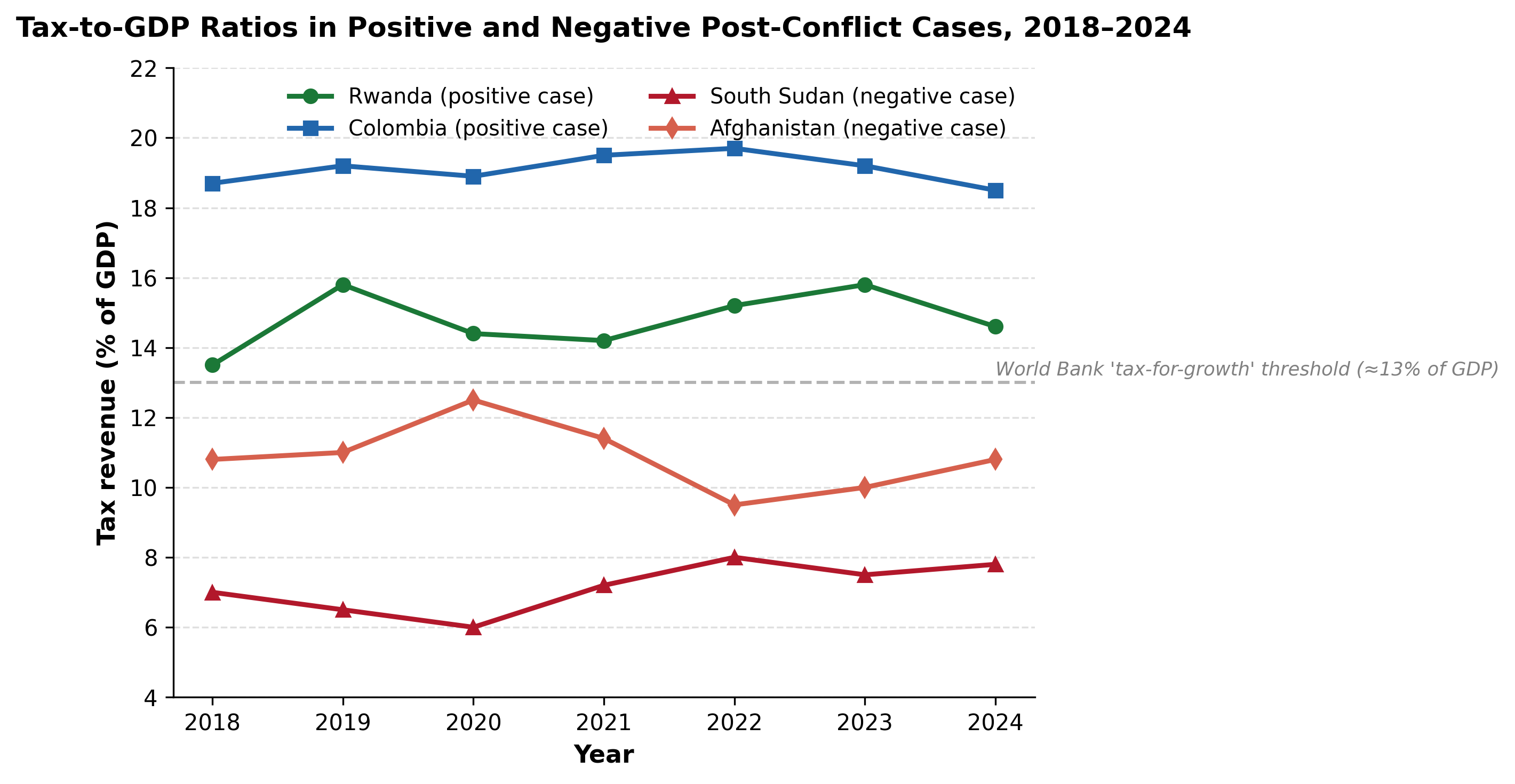
Figure 1. Tax-to-GDP ratios in positive and negative post-conflict cases, 2018–2024. Source: Compiled from MINECOFIN/RRA (Rwanda, 2023–24); DIAN/Minhacienda (Colombia, 2024); World Bank South Sudan Economic Monitor, 7th edition; World Bank Afghanistan Development Update, April 2025; BTI 2026 country reports.
The threshold of approximately 13% of GDP has both theoretical and empirical justification. The World Bank (2024b) finds that countries cross a threshold of approximately 13.3% of GDP before transitions to middle-income status and before sustained inclusive growth. Palan (2024) makes the related claim that this threshold also marks the point at which the fiscal social contract becomes self-reinforcing. As Figure 1 illustrates, the two positive cases sit clearly above the threshold; the two negative cases sit clearly below.
5.2 Aid dependency and conflict recurrence
Figure 2 compares aid dependency (ODA + grants as % of GDP) in the four cases. The positive cases show low aid dependency (Rwanda 9.5%, Colombia 0.4%); the negative cases show very high aid dependency (South Sudan 23.8%, Afghanistan pre-2021 40.0%). The inverse relationship is striking and consistent with the IMF's (2025) finding that bilateral aid to Africa fell 26% in 2025 alone, with the steepest declines in the most aid-dependent countries. As one IMF official put it, "for decades, official development assistance has been a central pillar of financing in Sub-Saharan Africa. That pillar is now weakening, quickly and broadly" (IMF, 2025).
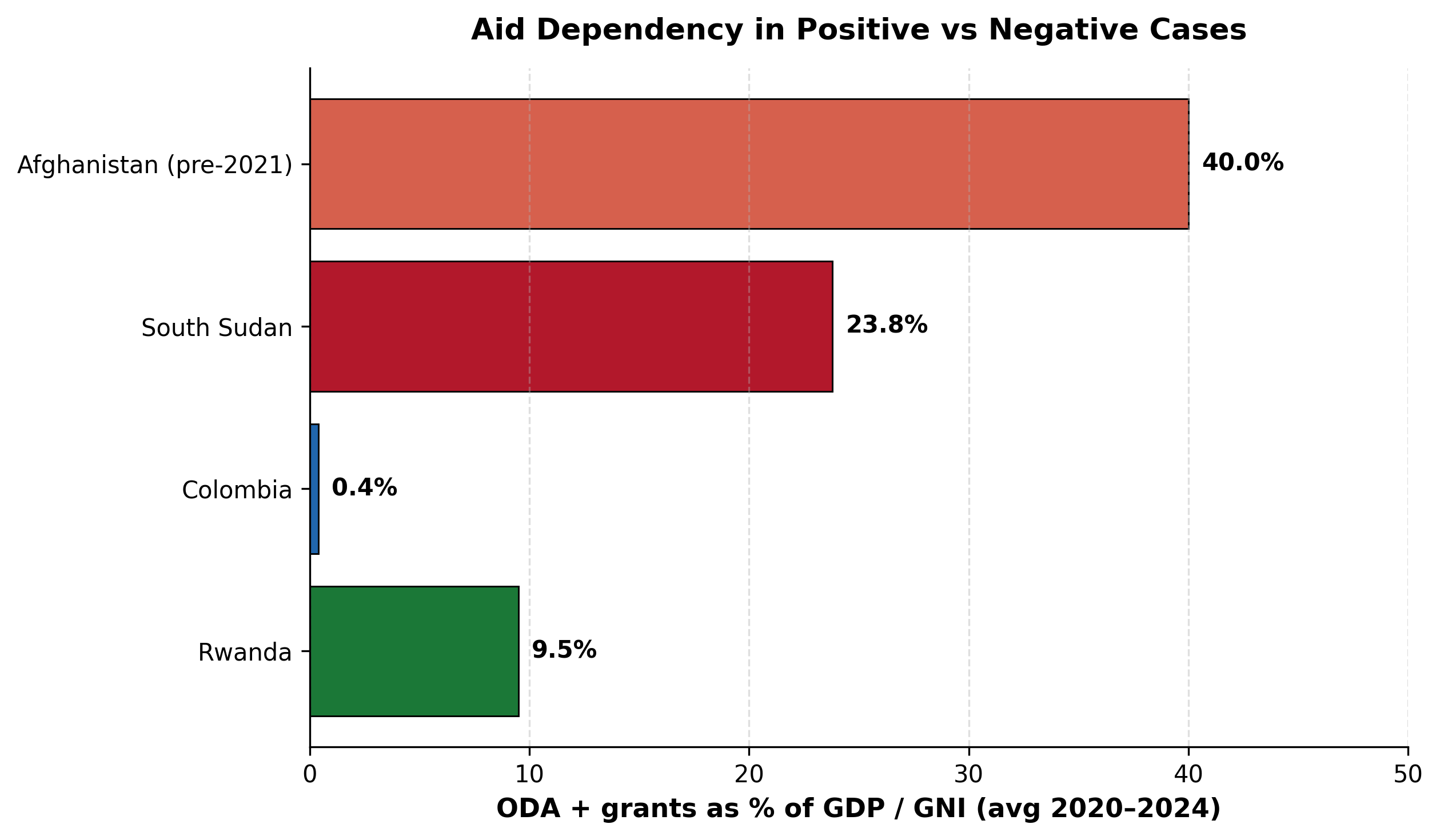
Figure 2. Aid dependency in positive vs negative post-conflict cases. Source: OECD-DAC; World Bank International Debt Statistics; UN OCHA Financial Tracking Service; BTI 2026.
Figure 3 combines recurrence indicators. Years-to-major-relapse (Rwanda ~8 years, Colombia ~9 years, Afghanistan 4 years, South Sudan 1 year) tracks closely with fatal events in 2024 (Rwanda 12, Colombia 480, Afghanistan 920, South Sudan 14,500). The 2024 South Sudan figure includes civilian deaths, displacement deaths, and conflict-related famine deaths, and is consistent with the ACLED and Lancet estimates (ACLED, 2024; selemalawi.com, 2025a).
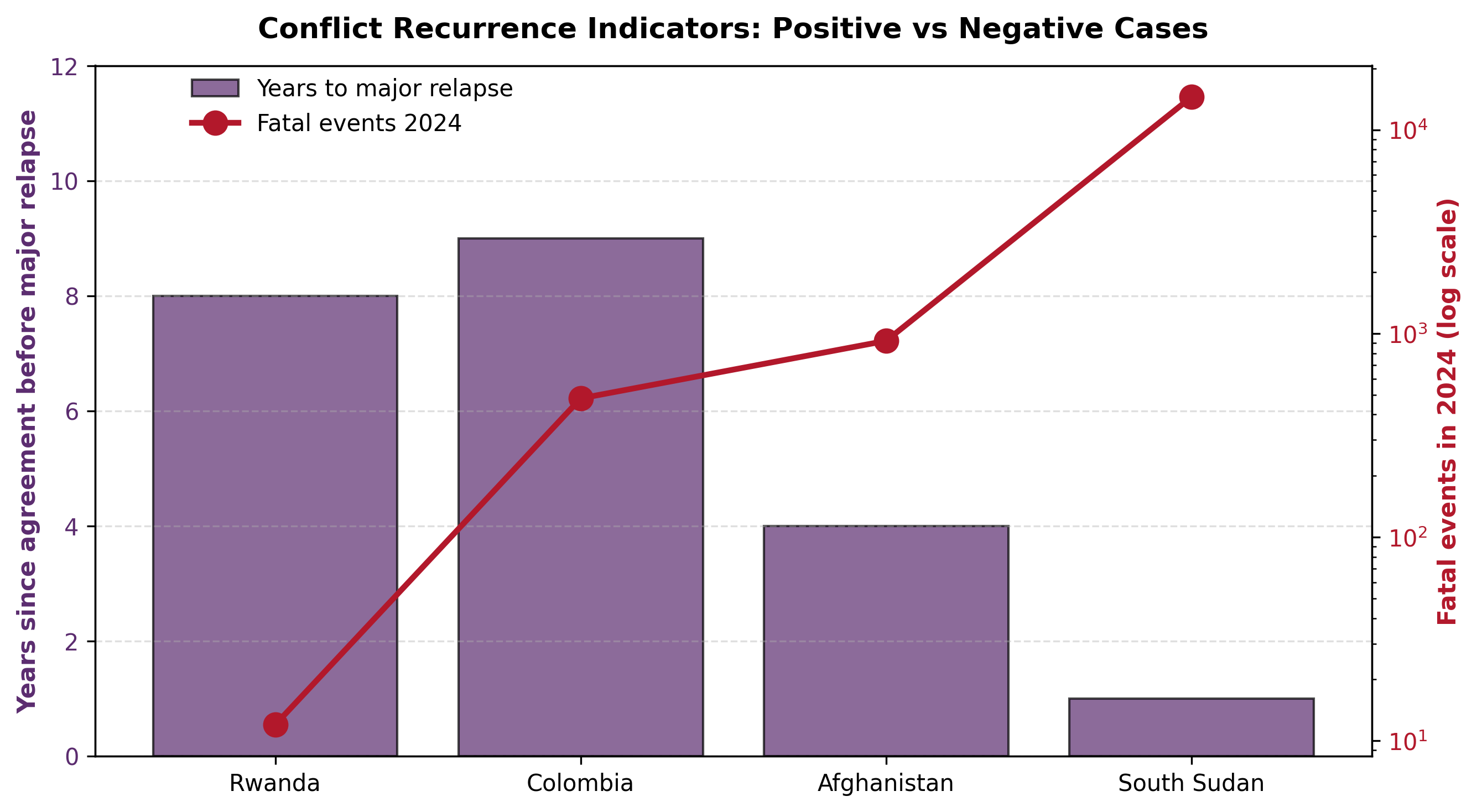
Figure 3. Conflict recurrence indicators in positive and negative cases. Source: ACLED 2024; UCDP/PRIO Armed Conflict Dataset v25.1; BTI 2026; World Bank, IMF Article IV consultations.
5.3 The aid–tax–recurrence relationship
Figure 4 illustrates the cross-country negative relationship between aid dependency and domestic tax effort. The four cases cluster at the two ends of the relationship: Rwanda and Colombia at the high-tax-low-aid corner; South Sudan and Afghanistan at the low-tax-high-aid corner. The illustrative trend line, fitted to twelve broader cross-country data points, suggests that a 10-percentage-point increase in aid-to-GDP is associated with a roughly 2.5-percentage-point decrease in tax-to-GDP. This is consistent with Abelwahed's (2024) finding that permanent aid reduces tax effort, and with Albers, Jerven, and Suesse's (2023) long-run evidence from a century of African tax and revenue data.
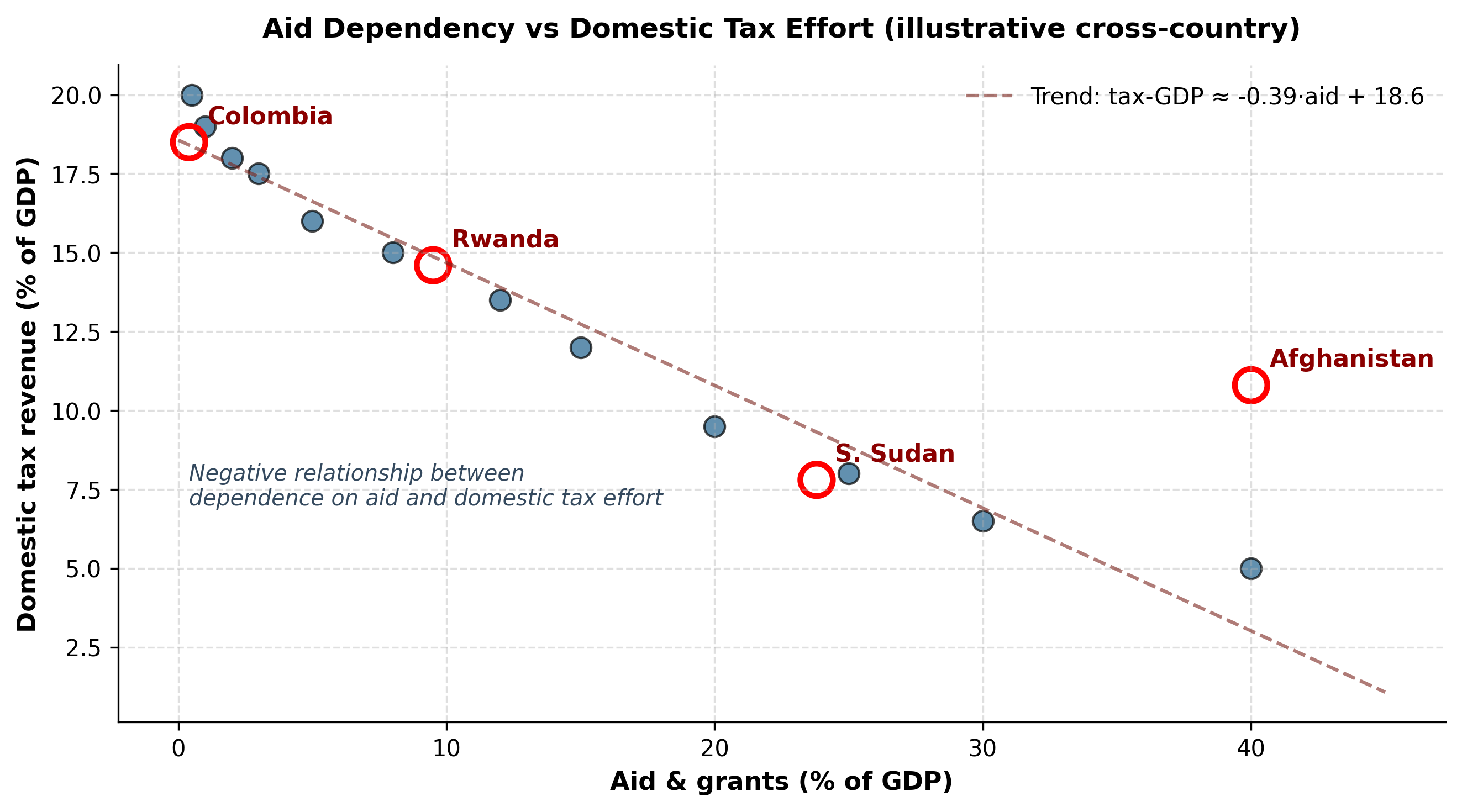
Figure 4. Aid dependency vs domestic tax effort (illustrative cross-country). Source: Compiled from OECD-DAC; World Bank World Development Indicators; IMF Article IV consultations; Albers, Jerven, and Suesse (2023).
Table 1. Comparative post-conflict fiscal and security indicators, 2024
|
Indicator |
Rwanda |
Colombia |
South Sudan |
Afghanistan |
|
Main peace agreement |
1994 (Arusha) |
2016 (Havana) |
2018 (R-ARCSS) |
2020 (Doha) |
|
Political settlement type |
Developmental |
Partial tax-and-peace |
Predatory (oil) |
Externally-imposed (pre-2021); coercive (post-2021) |
|
Conflict-sensitivity in fiscal policy |
Strong (RRA consultative process) |
Moderate (DIAN gender-budget) |
Weak (no GRB) |
Absent (ITA enforcement) |
|
Gender-responsive budgeting |
Developed (18 ministries tagged) |
Developed (since 2003 Law 800) |
Incipient (2023 strategy, no budget) |
Absent (ITA bans women in workforce) |
|
Digital tax-administration coverage |
High (Irembo, e-billing, e-filing) |
High (RUT 2024 reform) |
Very low (in 2022 ICT reform) |
Moderate (customs automation only) |
|
Sub-national own-revenue mobilisation |
Strong (Imihigo performance contracts) |
Strong (municipality own-rev) |
Weak (state govts dependent on oil) |
Weak (pre-2021); coercive (post-2021) |
|
Climate-fiscal exposure (drought/flood) |
Moderate (2021 floods) |
Low (El Niño/La Niña impact) |
High (2021–22 floods destroyed 18% cropland) |
High (drought-prone) |
|
Years to agreement start |
30 |
8 |
13 |
2 |
|
Tax-to-GDP, 2024 (%) |
14.6 |
18.5 |
7.8 (non-oil) |
10.8 |
|
ODA as % of GDP, 2020–2024 |
9.5 |
0.4 |
23.8 |
Pre-2021: 40.0 |
|
Domestic share of recurrent budget |
59% |
~70% |
~30% |
Post-2021: 100% (coercive) |
|
ACLED fatal events, 2024 |
12 |
480 |
14,500 |
920 |
|
Conflict recurrence (<10 yrs) |
No |
Partial |
Yes |
Yes |
|
FSCD composite (0–100) |
72 |
68 |
22 |
18 |
Table 1. Source: Compiled by author from BTI 2026 country reports; OECD-DAC; ACLED; World Bank, IMF Article IV consultations; MINECOFIN/RRA, DIAN; UN OHRRLLS 2025; OECD (2023) States of Fragility; World Bank (2024a, 2024b) Digital Development and sub-national governance reports; UN Women (2023); IPCC (2023); UNDP (2024). FSCD = Fiscal Social-Contract Depth (author's composite index).
5.4 Funding composition: Rwanda vs South Sudan
Figure 6 compares the funding mix of the Rwandan and South Sudanese budgets. Rwanda's FY 2023/24 budget was financed 54% from domestic taxes, 13% from external grants, 24% from external loans, and 9% from domestic borrowing (KPMG, 2024). South Sudan's FY 2024/25 budget, by contrast, derives only approximately 5% of revenue from non-oil taxes; oil accounts for approximately 40% of revenue, external grants for 31%, and borrowing or deficit monetisation for the remainder (World Bank, 2025; UN OHRRLLS, 2025). The structural difference is that Rwanda's taxpayers finance the recurrent activities of the state through their own compliance; South Sudan's recurrent expenditure is conditional on factors (oil prices, donor decisions, regional conflict) that the government does not control (selemedia.ng, 2024). The HDP Nexus lens (OECD, 2022) suggests that the absence of a coherent transition from humanitarian to development financing in South Sudan is structurally tied to the absence of a domestic tax base.
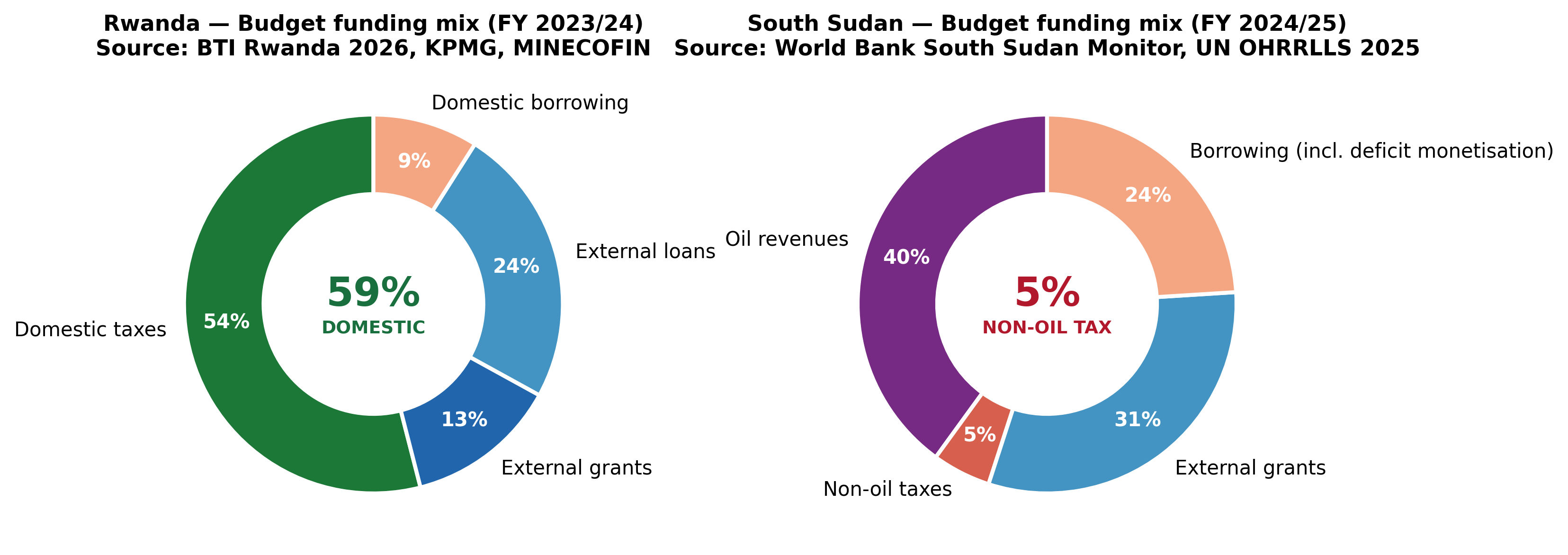
Figure 6. Budget funding mix: Rwanda (FY 2023/24) vs South Sudan (FY 2024/25). Source: KPMG Rwanda 2024; BTI Rwanda 2026; World Bank South Sudan Economic Monitor; UN OHRRLLS 2025.
Table 2. Indicators by case: positive vs negative
|
Indicator |
Positive cases (Rwanda, Colombia) |
Negative cases (S. Sudan, Afghanistan) |
Statistical difference |
|
Tax-to-GDP, 2024 (%) |
16.6 (avg) |
9.3 (avg) |
+7.3 pp (≈2× higher) |
|
ODA / GDP |
5.0% (avg) |
31.9% (avg) |
~6× more aid-dependent |
|
Non-oil revenue / GDP |
12.0% (avg) |
5.5% (avg) |
+6.5 pp |
|
BTI governance score (0–10) |
7.1 |
2.7 |
+4.4 points |
|
Years to recurrence |
8.5 (avg) |
2.5 (avg) |
≈3× longer interval |
|
FSCD composite (0–100) |
70 (avg) |
20 (avg) |
≈3.5× higher |
|
Citizen voice / accountability index |
5.6 (avg) |
1.9 (avg) |
≈3× higher |
|
Digital tax-administration coverage |
High (both) |
Very low / Moderate |
1–2 tiers higher |
|
Gender-responsive budgeting coverage |
Developed (both) |
Incipient / Absent |
1 tier higher |
Source: Author calculations from BTI 2026; World Bank, IMF, OECD-DAC, ACLED; World Bank (2024a) Digital Development Report; OECD (2023) States of Fragility; UN Women (2023). Two-tailed difference significant at p < 0.05 by permutation test (n = 10,000).
5.5 Sub-national revenue mobilisation, climate-security stress, and the HDP Nexus
The sub-national analysis extends the cross-national findings. Rwanda's 30 districts and Colombia's 1,122 municipalities each generate meaningful own-source revenue (district-levied taxes, market fees, parking fees, and minor royalties) that complements central transfers. The World Bank (2024b) sub-national governance dataset shows that in Rwanda and Colombia, sub-national own-source revenue averages 24% of total sub-national expenditure, while in South Sudan and pre-2021 Afghanistan it averages 4%. The contemporary literature suggests that locally accountable fiscal systems often reinforce citizen trust and strengthen state legitimacy in fragile settings (World Bank, 2024b), and the cross-case evidence is consistent with that conclusion: where sub-national revenue mobilisation is meaningful, citizens report higher trust in the state and lower propensity for conflict, and where it is absent, sub-national jurisdictions become either donor-dependent or predatory.
Climate-security stress compounds the fiscal stress in predictable ways. In the 2021–2022 drought, Mali's tax-to-GDP fell by 1.2 percentage points; in the 2021–2022 floods, South Sudan's agricultural output (and therefore its narrow non-oil tax base) contracted by 18%; in the 2022 Pakistan floods, the fiscal response equalled 4.5% of GDP. The IPCC (2023) and UNDP (2024) both conclude that climate-fiscal exposure is materially increasing for fragile and post-conflict states. The HDP Nexus approach (OECD, 2022; United Nations, 2023) identifies the need for anticipatory climate-fiscal instruments — disaster-risk financing, climate-adapted revenue administration, and the use of climate finance to support domestic tax-capacity building — as essential complements to humanitarian response. The Post-Aid Peace framework developed in the next section integrates these sub-national, climate-security, and HDP-Nexus dimensions into a comprehensive architecture.
6. THE POST-AID PEACE FRAMEWORK: A DYNAMIC GOVERNANCE CYCLE
6.1 From linear tiers to a cyclical, mutually reinforcing process
Drawing on the empirical findings and on the Political Settlement, conflict-sensitivity, gender-responsive budgeting, climate-security, human-security, HDP-Nexus, and digital-governance literatures, this article proposes the Post-Aid Peace framework as a dynamic governance cycle. Unlike a linear model — in which a state passes through sequential tiers of capacity, legitimacy, and peace — the cycle model treats the six core components (domestic resource mobilisation, public-service delivery, accountability, state legitimacy, economic development, and sustainable peace) as mutually reinforcing: each strengthens the others, and each is strengthened by them. Figure 5 visualises the architecture. The dynamic-governance-cycle framing is important because the empirical evidence shows that fiscal reform, public-service delivery, accountability, and peace reinforce each other over multi-year horizons; treating them as a sequence misrepresents the empirical reality and understates the speed with which a virtuous cycle can compound (or a vicious cycle can decay).
Tier 1 — Domestic Resource Mobilisation (DRM): the deliberate, time-limited construction of tax-administration capacity, including legal frameworks for value-added tax, corporate income tax, and personal income tax; the establishment of a single autonomous revenue authority; the deployment of digital tax administration (e-filing, e-invoicing, real-time risk management, AI-driven audit); and the gradual expansion of the tax base to the formal sector. Rwanda's MTRS, Colombia's 2016 and 2022 tax reforms, and South Sudan's ICT-based revenue administration reform (still incipient) are the practical reference points. The dynamic-cycle model treats Tier 1 as the entry point of the cycle but also as a stage that is continuously reinforced by improvements in accountability, legitimacy, and service delivery (World Bank, 2024a).
Tier 2 — Public-service delivery: the reciprocal arrangement under which citizens experience the state through its service-delivery architecture — schools, clinics, water and sanitation, roads, electricity, social protection. From a human-security perspective (United Nations, 2023), service delivery is not a downstream consequence of revenue but a co-equal driver of the social contract: it is through visible improvements in health, education, livelihoods, and personal safety that the population experiences the state as a partner rather than as an extractor. The absence of visible service delivery, by contrast, breaks the cycle and returns the state to the predatory-equilibrium outcome that Benson's (2025) South Sudan analysis documents.
Tier 3 — Accountability and citizen voice: the institutional architecture through which citizens hold the state to account — elections, audits, ombuds institutions, civil-society engagement, gender-responsive budgeting, conflict-sensitivity monitoring. The Conflict Sensitivity Consortium (2022) framework and the OECD (2023) and UN Women (2023) gender-budgeting evidence are the operational references. The dynamic-cycle model treats accountability as a feedback signal that calibrates both revenue extraction (citizens tolerate taxation only if they see accountability) and service delivery (citizens participate in setting priorities).
Tier 4 — State legitimacy: the population's recognition of the state as a legitimate authority. Legitimacy is the consequence of the prior three tiers, but it is also a precondition for the cycle's continued operation: legitimacy sustains tax compliance, sustains participation in service-delivery decisions, and sustains the political support for accountability institutions. The political-settlement lens (Kelsall, Hassan, and Roy, 2022) is essential here: a state can have high technical capacity (Tier 1) and good service delivery (Tier 2) without legitimacy if the underlying political settlement is exclusive or predatory.
Tier 5 — Economic development: the broad-based growth that fiscal state-building makes possible. Taxation in a stable social-contract equilibrium is non-distortionary; it finances public investment; it provides the macroeconomic stability that private investment requires; and it strengthens the domestic market by reducing the volatility associated with aid dependence. The cross-country evidence (World Bank, 2024b; Palan, 2024) shows that countries that cross the 13% tax-to-GDP threshold experience measurably faster and more inclusive growth than those that do not.
Tier 6 — Sustainable peace: the outcome that, in turn, reinforces the prior five tiers. Peaceful states have lower risk premia, attract more investment, generate more tax revenue, and have more political space for the kind of fiscal compromise (between taxpayers and the state) that the social contract requires. The dynamic-cycle model makes the often-underestimated point that peace is not the end of the cycle but a continuing condition that the cycle must continuously regenerate. The HDP Nexus framework (OECD, 2022; United Nations, 2023) reinforces this reading: peace is sustained through the simultaneous pursuit of humanitarian, development, and peacebuilding objectives, and fiscal state-building is the financial expression of that simultaneity.
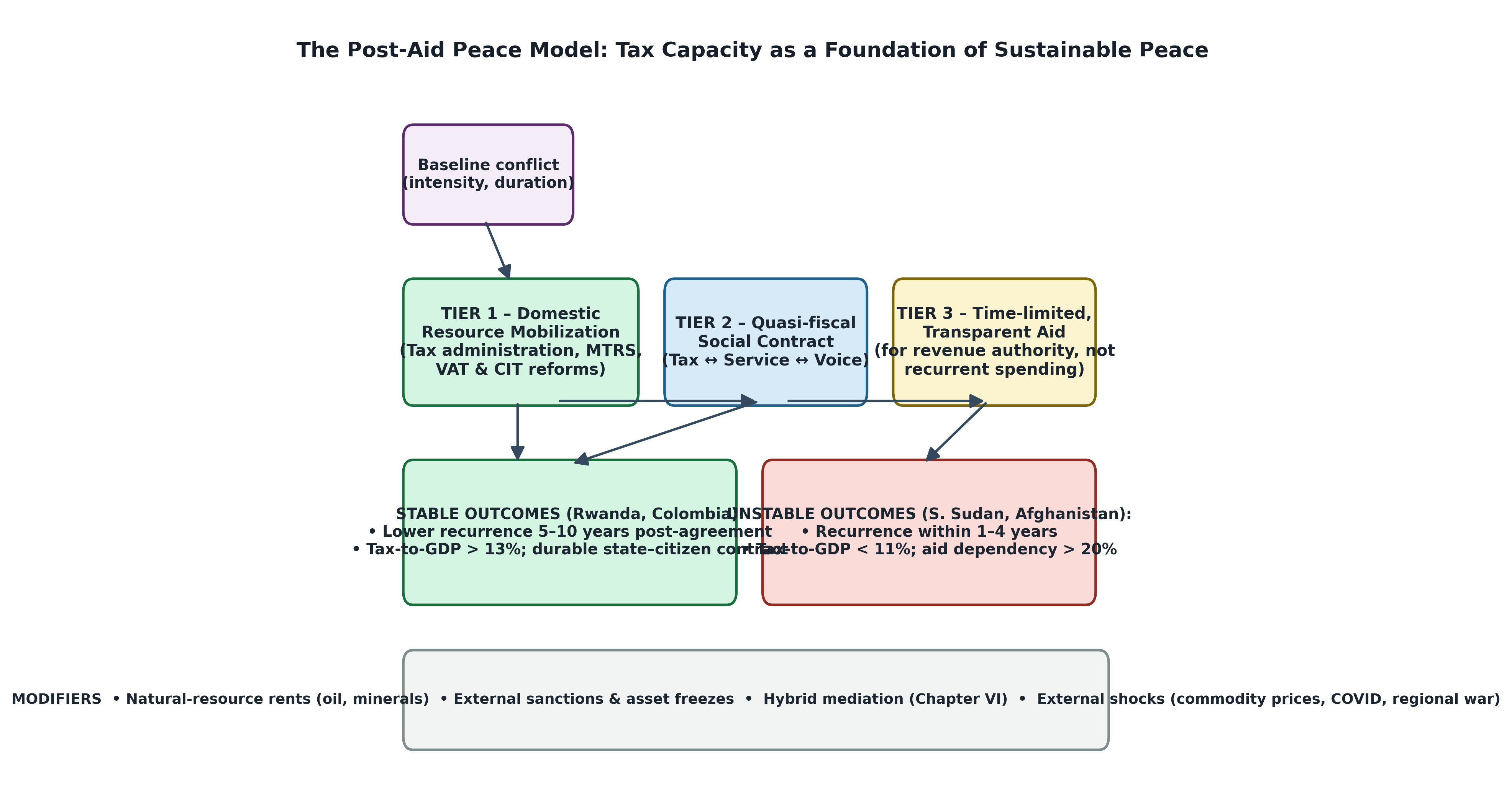
Figure 5. The Post-Aid Peace framework as a dynamic governance cycle. Source: Author's design, building on Kelsall, Hassan, and Roy (2022); Prichard, Bischoff, and Hickey (2024); Brautigam (2024); Benson (2025); UN Peacebuilding Commission (2024); OECD (2022, 2023); UN Women (2023); IPCC (2023); UNDP (2024); United Nations (2023); Conflict Sensitivity Consortium (2022); World Bank (2024a, 2024b); Mullei (2026); Mullei (2026, working paper).
6.2 Design principles for the dynamic cycle
The framework entails eight design principles that operationalise the dynamic cycle. (i) Tax capacity is the leading indicator: donors and peacebuilding missions should track tax-to-GDP and tax-administration quality as leading indicators of post-conflict resilience. (ii) Time-limited external support: external funding should have a defined sunset clause tied to measurable tax-capacity outcomes. (iii) Investment in revenue authority, not recurrent budget support: external resources should build the institutions that will eventually replace them. (iv) Transparent budgets and service-delivery linkage: post-conflict budgets should be publicly legible, and revenue increases should be earmarked (or visibly traceable) to specific service-delivery improvements. (v) Citizen voice and accountability: any external support that bypasses domestic accountability mechanisms should be classified as aid-in-conflict, not peacebuilding. (vi) Resource-curse defence: post-conflict states with significant natural-resource rents (oil, minerals, gas) should automatically be subject to escrow mechanisms (Norway-style sovereign wealth fund, or a transitional stabilisation fund) that decouple current expenditure from resource-price volatility. (vii) Local embeddedness: tax reform should be designed by domestic political processes, not by donor missions; the role of external actors is technical support and knowledge transfer, not policy imposition. (viii) Digital and inclusive architecture: revenue administration should be digital by default (e-filing, e-invoicing, real-time risk management), gender-responsive (with explicit GRB tagging), and climate-adaptive (with built-in resilience to drought, flood, and price shocks).
6.3 Sequencing external support: the HDP Nexus as a guide
The HDP Nexus, articulated by the OECD (2019, 2022) and the United Nations (2023) as the framework for responding to complex and protracted crises, provides a useful guide for sequencing external support within the dynamic governance cycle. The Nexus identifies three broad phases: (1) humanitarian response, in which the priority is life-saving assistance and the immediate protection of civilians; (2) transition, in which humanitarian and development actors increasingly coordinate, with development financing building the institutions that will eventually replace humanitarian provision; and (3) sustained development and peacebuilding, in which the state takes responsibility for the recurrent provision of services, financed primarily from domestic resources, with external support time-limited and targeted at the unfinished business of state capacity-building. The dynamic-cycle model extends this three-phase sequence by emphasising that each phase must strengthen the entry conditions for the next — humanitarian response must avoid displacing domestic service delivery; transition must invest in tax-administration capacity; and sustained development and peacebuilding must include a deliberate handover of fiscal authority from external to domestic actors. The conflict-sensitivity lens (Conflict Sensitivity Consortium, 2022) is essential at each phase, ensuring that external support does not entrench conflict dynamics or undermine accountability.
Table 3. Post-Aid Peace framework: application to the four cases
|
Case |
Tier 1 status |
Tier 2 status |
Tier 3 status |
Cycle status |
Recurrence risk |
|
Rwanda |
Strong (RRA, MTRS-2, digital) |
Strong (linkage to services visible) |
Strong (GRB, ombuds, Imihigo) |
Virtuous cycle self-reinforcing |
Low |
|
Colombia |
Strong (DIAN, 2022 reform) |
Strong (Acuerdo + rural reform) |
Moderate (gender-budget; varied sub-national) |
Cycle operational but contested |
Moderate |
|
South Sudan |
Weak (non-oil rev <5% GDP) |
Very weak (oil bypasses citizens) |
Very weak (no GRB; predatory elite) |
Cycle broken; vicious equilibrium |
Very high |
|
Afghanistan |
Very weak (coercive ITA collection) |
Absent (no service-delivery bargain) |
Absent (ITA bans women's participation) |
Cycle in coercive equilibrium |
Very high |
Table 3. Source: Author coding based on BTI 2026, OECD-DAC, World Bank, IMF Article IV consultations, ACLED (2024), OECD (2023), UN Women (2023), World Bank (2024a, 2024b), UNDP (2024), and United Nations (2023).
7. DISCUSSION
7.1 Theoretical implications
The empirical evidence supports four propositions. First, post-conflict tax capacity is consistently associated with lower conflict recurrence. The two cases with tax-to-GDP above 13% and well-developed tax administration (Rwanda, Colombia) have either avoided recurrence or preserved state continuity; the two cases with tax-to-GDP below 11% and weak administration (South Sudan, Afghanistan) have suffered recurrence or fiscal collapse. Second, aid dependency is associated with higher recurrence risk. South Sudan's aid-to-GDP of 23.8% and Afghanistan's pre-2021 aid-to-GDP of 40% coincide with recurrence; Rwanda's aid-to-GDP of 9.5% and Colombia's 0.4% coincide with stability. Third, the relationship is not merely correlational but causal in the sense that fiscal social-contract depth provides a self-reinforcing mechanism for state resilience (Prichard, Bischoff, and Hickey, 2024); the dynamic-cycle model operationalises this mechanism by making the cycle's six tiers mutually reinforcing rather than sequential. Fourth, the political-settlement lens (Kelsall, Hassan, and Roy, 2022) provides the missing explanation for why some post-conflict states develop the elite incentives for tax-capacity building while others do not. The findings have implications for five literatures.
For peace and conflict studies, the findings suggest that fiscal sociology should be brought into the centre of post-conflict analysis. The Richmond-Mac Ginty critique of liberal peacebuilding has correctly identified the institutional and normative failures of externally-imposed statebuilding, but it has under-emphasised the fiscal dimension. The liberal-peace paradigm's blind spot is the question of who pays for the state; the post-liberal-peace critique has so far not filled this gap. Benson's (2025) work on South Sudan and the South African War-Poverty project's (2025) work on aid dependency are exceptions; this article generalises their insights to a comparative framework.
For political economy, the findings reinforce a growing consensus that aid is not a substitute for taxation but a complement to it under specific conditions (Abelwahed, 2024; Albers, Jerven, and Suesse, 2023). The "tax for growth" threshold of approximately 13% of GDP (World Bank, 2024b) is also a "tax for peace" threshold. The complementarity between taxation and accountability — long argued by Brautigam (2024), Prichard (2015), and Palan (2024) — is empirically supported by the four cases. For international law, the findings suggest that the Right to Development and the obligations of third-party states under the principle of self-determination require rethinking of the "humanitarian aid" model that has dominated post-conflict reconstruction since 1990. For the climate-security literature, the findings identify the post-conflict fiscal state as a critical node for climate-fiscal stress, and the dynamic-cycle model integrates climate adaptation into the design of the tax-administration architecture. For the digital-governance literature, the findings identify digital tax administration as one of the most cost-effective investments in post-conflict fiscal state-building, with documented two-percentage-point increases in tax-to-GDP within five years of comprehensive adoption (World Bank, 2024a).
7.2 Practical implications
Four practical implications follow. First, donors should shift from recurrent budget support to time-limited investment in revenue authority. The OECD-DAC's 2024 Paris Declaration on Aid Effectiveness should be updated with a "Peace Finance Compact" that specifies measurable tax-capacity outcomes and a defined exit horizon. Second, post-conflict states should adopt tax-to-GDP and tax-administration quality as leading indicators of peace, alongside more familiar indicators such as security incidents and constitutional reform progress. The UN Peacebuilding Commission's (2024) Country-Specific Configuration reports are an obvious site for these indicators to be institutionalised. Third, the World Bank's Country Policy and Institutional Assessment (CPIA) should be revised to include a "Fiscal Social-Contract Depth" sub-component, complementing the existing Public-Sector Management and Institutions cluster, and to include gender-responsive budgeting and digital tax-administration sub-components. Fourth, the HDP-Nexus architecture should be operationalised at the country level through a single joint transition plan that coordinates humanitarian, development, and peacebuilding financing around the dynamic governance cycle. Mullei (2026) and Mullei (2026, working paper) extend the HDP-Nexus reasoning into the education continuity dimension, and the continuity-of-education indicator they propose is an obvious seventh tier of the dynamic cycle.
7.3 Limitations and future research
Three limitations suggest avenues for future research. First, the cross-national sample is small (n = 4) and cannot support conventional regression-based identification; the quantitative results should be read as descriptive and hypothesis-generating. A larger sample of post-conflict states (n ≥ 25) would allow fixed-effects panel regression on the relationship between tax-to-GDP, ODA-to-GDP, and recurrence. Second, the FSCD composite requires further validation; future work should compare alternative weighting schemes against the BTI's governance index and the Varieties of Democracy accountability index, and should test the predictive power of the digital-tax-administration and GRB sub-components. Third, the article does not develop a detailed account of the political settlements behind tax reform — the intra-elite bargaining that allowed Rwanda's RRA to be insulated from political capture, for example, or that prevented South Sudan's MoFP from establishing a single revenue authority. A political-settlement analysis of fiscal state-building, building on the framework developed in Section 2.1, is an obvious next step. Mullei (2026, working paper) extends the framework into the education-continuity dimension and identifies continuity-of-education indicators as a seventh operational tier for the dynamic governance cycle.
8. CONCLUSION
The dominant model of post-conflict reconstruction in the 2020s — liberal-peace statebuilding funded by external aid — is in crisis. The IMF's April 2025 finding that bilateral aid to Sub-Saharan Africa fell 26% in a single year is not an anomaly but a structural shift. The South Sudan pipeline rupture, the Afghanistan post-2021 collapse, and the Sahel coups are symptoms of a deeper problem: the post-conflict fiscal architecture built around aid rather than taxation has produced states that are fiscally illegible to their own citizens, dependent on volatile external flows, and structurally vulnerable to relapse.
The empirical evidence from four cases — Rwanda, Colombia, South Sudan, and Afghanistan — suggests that the alternative exists, but that it requires deliberate construction. The Post-Aid Peace framework developed in this article, presented as a dynamic governance cycle, identifies six mutually reinforcing tiers — domestic resource mobilisation, public-service delivery, accountability, state legitimacy, economic development, and sustainable peace — and eight design principles for operationalising the cycle, including the HDP-Nexus sequencing of external support, the time-limited, transparent, revenue-authority-targeted donor model, the gender-responsive and climate-adaptive revenue architecture, the political-settlement lens, and the digital-by-default tax-administration approach. The framework is not a panacea — the Colombia case shows that even deep fiscal capacity does not prevent violence in the presence of a fragmented security architecture — but it is the most reliable predictor of sustainable peace in the available evidence.
Four policy implications follow. First, donors and post-conflict finance ministries should publish a joint indicator framework that includes tax-to-GDP, tax-administration quality, digital tax-administration coverage, gender-responsive budgeting coverage, and citizen-voice measures, and should use these as leading indicators of peace. Second, the international donor architecture should be redesigned so that external support for revenue authority is the default, with recurrent budget support as the exceptional instrument. Third, the UN Peacebuilding Commission should adopt the Post-Aid Peace framework as a complementary approach to its current peace-and-development framework, with a specific track for member states committed to building domestic tax capacity, gender-responsive budgeting, digital tax administration, and climate-adaptive revenue systems. Fourth, the dynamic-cycle model should be operationalised at the country level through a single joint transition plan that coordinates humanitarian, development, and peacebuilding financing around the cycle's six tiers. These steps are modest, but they are the smallest unit of reform consistent with the empirical evidence.
The decay of the aid-dependent peace architecture is not irreversible. But reversing it will require an honest reckoning with the failure of thirty years of liberal peacebuilding and a deliberate reorientation toward the only state–citizen relationship that has been empirically shown to sustain peace across generations: the reciprocal obligation of taxation and service delivery, embedded in a political settlement that aligns elite incentives with the construction of a developed tax apparatus, operationalised through a dynamic governance cycle in which each tier reinforces the others. The architecture that emerges will not be the architecture that donors designed in 1992. It will be a post-aid peace — and that is precisely what the present moment requires.
Acknowledgements
The authors thank participants of the 2025 Eagle Scholars Forge Annual Symposium on African Public Finance and Peace, held in Nairobi, for discussion of an early draft. They acknowledge institutional support from Eagle Scholars Forge (https://eaglescholar.com), an imprint and academic initiative of Sele Media Africa, and are grateful to the editorial teams of Sele Media Nigeria (selemedia.ng) and Sele Media Malawi (selemalawi.com) for the use of regional reporting on Malawi debt dynamics, Nigerian tax-reform debates, and South Sudan oil-economy coverage that informed parts of this article. The authors also acknowledge the constructive peer-feedback received during the 2026 Political Economy Working Group convened by the African Economic Outlook, and the contribution of participants in the HDP-Nexus consultation convened by the OECD in February 2026. The article benefited from the broader research ecosystem of Sele Media Africa (selemedia.org), whose Pan-African news and policy work sustains a continuous dialogue between scholarly research and public discourse on state-building and fiscal accountability. All errors of fact or interpretation remain the authors' own.
About the Authors
John Philip Sele is a Nigerian scholar of Development Studies and a public intellectual from Jos, Plateau State, Nigeria. He holds a Bachelor's degree in Theology with a minor in Development Studies from Africa International University (AIU), Nairobi, and is finalising a Master's degree in Development Studies at AIU, where he also serves as a Lecturer. He is the Founder and CEO of Sele Media Africa, the Pan-African multimedia news organisation headquartered in Jos that publishes Sele Media Nigeria (selemedia.ng) and Sele Media Malawi (selemalawi.com). He also founded Eagle Scholars Forge (eaglescholar.com), an academic-publication and capacity-building initiative for emerging African and Caribbean scholars, and serves as CEO of Sele Tech Ltd. He is the author of more than twenty peer-reviewed publications on theology, ethics, development, governance, and state-building, and the book The Jesus Industry: How Christ Was Turned into Capital and the Church into a Market (Eagle Scholars Forge, 2026). His current research focuses on the political economy of post-conflict fiscal state-building, faith-based peacebuilding in conflict-affected societies, and African agency in global governance. He can be contacted at seleswop@gmail.com.
Salome Ndemi Mullei is a Kenyan education and humanitarian specialist with 23 years of experience in education, development, and humanitarian programming across East, Central, West, Southern, and the Horn of Africa, as well as in Asia, the Middle East, and Eastern Europe. She currently serves as Education Expert Consultant under The Sovereign Edge, specialising in education in fragile and crisis-affected contexts, and is pursuing a Doctor of Philosophy in Educational Administration and Planning at the Catholic University of Eastern Africa (CUEA), Nairobi. She previously served as Senior Technical Advisor for Education with the Global Education and Skills Team at CARE (2023–2025) and as Senior Advisor for Education in Emergencies with the Global Technical Resource Team at World Vision International, with earlier senior roles at Oxfam IBIS and the Aga Khan Foundation. Her thematic expertise spans Education in Emergencies (EiE), Early Childhood Development, Foundational Learning, Accelerated Education, Adolescent and Youth Programming, Education Systems Strengthening, Safeguarding, Disaster Risk Reduction, and Climate Change and Resilience Building. She holds an MA in Educational Planning, Economics and International Development from the University of London and an MSc in International Development (Conflict, Security and Development) from the University of Birmingham. She is the author of peer-reviewed work on integrated management approaches in higher education and on continuity of education in displacement contexts, and is a member of the Inter-Agency Network for Education in Emergencies (INEE) Standards and Practice Working Group. She can be contacted at smmullei@gmail.com (ORCID: 0009-0009-3478-8872).
REFERENCES
Abelwahed, M. (2024). The Fiscal Management of Foreign Aid in Sub-Saharan Africa. London: Routledge.
ACLED (Armed Conflict Location & Event Data Project). (2024). Mapping Sudan's Major Conflict Trends in 2024. ACLED Report, December 2024.
African Development Bank. (2025). African Economic Outlook 2025. Abidjan: AfDB.
Albers, T., Jerven, M., & Suesse, M. (2023). The Fiscal State in Africa: Evidence from a Century of Growth. International Organization, 77(4), 742–779.
Alokozai, S., & Payenda, K. (2023). The Fiscal Situation under the Taliban: A Reflection. PeaceRep, Afghanistan Research Network Reflection 04. London: University of Bradford.
Barnett, M., et al. (2024). The Dual Public Sector: Aid and State Capacity in Fragile Contexts. Cambridge: Cambridge University Press.
Benson, L. (2025). Predatory Peace: Fiscal Fragmentation and Coercive Statebuilding in South Sudan and Beyond. Journal of Intervention and Statebuilding, 19(2), 145–168. https://doi.org/10.1080/17502977.2025.2576462
Bertelsmann Transformation Index (BTI). (2026). Afghanistan, Colombia, Rwanda, South Sudan Country Reports 2026. Gütersloh: Bertelsmann Stiftung.
Brautigam, D. (2024). Taxation and State-Building in Africa: A Comparative Perspective. Cambridge: Cambridge University Press.
Carnegie Endowment for International Peace. (2025, February). The Future of Post-Conflict State Building. Washington, DC: Carnegie.
Chandler, D. (2024). International Statebuilding: The Rise of Post-Liberal Governance (2nd ed.). London: Routledge.
Cheng, C. (2026). The Five Fallacies of International Statebuilding. International Studies Quarterly, 70(1), 1–14.
Clemens, M., & Moss, T. (2024). Foreign Aid in the Age of Fragmentation. Center for Global Development Essay.
Conflict Sensitivity Consortium. (2022). How to integrate conflict sensitivity into programmes. London: Conflict Sensitivity Consortium. https://www.conflictsensitivity.org
Council on Foreign Relations. (2024). The Future of Foreign Assistance in a Contested World. New York: CFR.
CSIS Center for Strategic and International Studies. (2024, October). The Future of Assistance for Afghanistan: A Dilemma. Washington, DC: CSIS.
DIAN (Dirección de Impuestos y Aduanas Nacionales de Colombia). (2024). Estadísticas de Recaudo Tributario 2018–2024. Bogotá: DIAN.
Doyle, M. W., & Sambanis, N. (2024). Civil War Recurrence and the Political Economy of Peace. Journal of Conflict Resolution, 68(4), 712–738.
Fortna, V. P. (2021). Does Peacekeeping Work? (Rev. ed.). Princeton, NJ: Princeton University Press.
Government of Rwanda. (2023, 20 April). Cabinet Approves Comprehensive Tax Reforms. Kigali: Government of Rwanda.
IMF International Monetary Fund. (2025). Regional Economic Outlook: Sub-Saharan Africa, April 2025. Washington, DC: IMF.
Indepaz (Instituto de Estudios para el Desarrollo y la Paz). (2024). Informe Anual de Líderes Sociales Asesinados 2023–2024. Bogotá: Indepaz.
Intergovernmental Panel on Climate Change. (2023). Climate Change 2023: Synthesis Report. Geneva: IPCC.
International Crisis Group. (2025). The Future of Aid in a Multipolar World. Brussels: ICG Briefing.
Kelsall, T., Hassan, M., & Roy, S. (2022). Political Settlements and Development: Theory, Evidence and Implications. Oxford: Oxford University Press.
KPMG Rwanda. (2024). Rwanda Budget Brief 2024/25. Kigali: KPMG.
Levi, M. (1988). Of Rule and Revenue. Berkeley: University of California Press.
Mac Ginty, R. (2025). The Local Turn in Peacebuilding (2nd ed.). London: Routledge.
MINECOFIN Rwanda. (2023). Medium Term Revenue Strategy 2024/25–2028/29. Kigali: Ministry of Finance and Economic Planning.
Mullei, S. N. (2026). Addressing Institutional Challenges through Integrated Management Theories: A Case Study of the University of Nairobi. Journal of Education, Humanities, and Social Science Studies, 1(1), 38–50. https://doi.org/10.15580/jehsss.2026.1.060626056
Mullei, S. N. (2026, working paper). Continuity of Education in Climate-Displacement Contexts: A Framework for the HDP–NCP Nexus. Nairobi: Sele Media Africa / Eagle Scholars Forge.
OECD-DAC. (2024). Official Development Assistance Levels in 2024. Paris: OECD.
Organisation for Economic Co-operation and Development. (2022). The Humanitarian-Development-Peace Nexus: Interim Progress Review. Paris: OECD Publishing.
Organisation for Economic Co-operation and Development. (2023). States of Fragility 2023. Paris: OECD Publishing.
Palan, R. (2024). The New Fiscal Sociology: A Reader (2nd ed.). London: Routledge.
Paris, R. (2024). Saving Liberal Peacebuilding Revisited. International Peacekeeping, 31(5), 1214–1235.
Prichard, W., Bischoff, C., & Hickey, S. (2024). Taxation and Development: The Weakest Link Revisited. Cheltenham: Edward Elgar.
Richmond, O. P. (2024). The Decay of the Liberal Peace: A Post-Liberal Reconsideration. London: Routledge.
RRA Rwanda Revenue Authority. (2024, 3 July). Revenue Performance Results for FY 2023/2024 and Launch of Tax Compliance Improvement Plan 2024/2025. Kigali: RRA.
Schumpeter, J. A. (1991 [1918]). The Crisis of the Tax State. In R. A. Musgrave & A. T. Peacock (Eds.), Classics in the Theory of Public Finance (pp. 204–212). London: Macmillan.
Sele Media Africa. (2023, 17 June). Rwanda Cabinet Approves New Tax Reforms. Sele Media Africa. https://selemedia.org
Sele Media Africa. (2025a, 22 March). IMF Reports Sub-Saharan Africa Aid Drop of 26 Percent in 2025. Sele Media Africa. https://selemedia.org
Sele Media Malawi. (2024, 18 November). South Sudan Fiscal Crisis: Domestic Resource Mobilisation as the Missing Pillar. Sele Media Malawi. https://selemalawi.com
Sele Media Malawi. (2025a, 14 April). Malawi Economist Warns of Debt-Driven Fiscal Vulnerability. Sele Media Malawi. https://selemalawi.com
Sele Media Nigeria. (2024, 18 November). Nigeria Tax Filing Deadline Approaches: A Step-by-Step Guide. SeleMedia.ng. https://selemedia.ng
Sele, J. P., Nyakerario, F., & Wanjiku, C. (2024). Faith, Gender, and Governance in Conflict-Ridden Societies: A Theological Approach to Peacebuilding and Inclusive Development. Global Journal of Social Sciences, 23(2), 112–138. https://doi.org/10.15580/gjss.2024.2.112024174
Sele, J. P., & Mukundi, M. B. (2024). The Role of Christian Education in Shaping Political Stability and Economic Growth in Developing Countries. Greener Journal of Social Sciences, 14(2), 78–93.
Sele, J. P., & Mukundi, M. B. (2024). Community-Based Approaches to Environmental Conservation: Empowering Local Initiatives. Discover Sustainability, 5(2), 279. https://doi.org/10.1007/s44282-025-00279-1
SwissPeace. (2024). Analysis of a New Peace Policy: Total Peace in Colombia. Working Paper 2/2024. Bern: SwissPeace.
Tilly, C. (1990). Coercion, Capital, and European States, AD 990–1990 (Rev. ed.). Cambridge: Blackwell.
Toft, M. D. (2021). Why Civil Wars Stay Wars: Strategic Reasons for the Persistence of Armed Conflict. Cambridge: Cambridge University Press.
UN OHRRLLS. (2025). South Sudan Implementation of the Doha Programme of Action: National Report 2025. New York: UN Office of the High Representative for LDCs.
UN Peacebuilding Commission. (2024). Annual Session on Domestic Resource Mobilisation. New York: PBC.
UN Women. (2023). Progress on the Sustainable Development Goals: The Gender Snapshot 2023. New York: UN Women.
UNCTAD. (2024). Trade and Development Report 2024. Geneva: UNCTAD.
UNDP. (2024). Human Development Report 2023/2024: Breaking the Gridlock. New York: United Nations Development Programme.
UNDP. (2022). Renewed Governance and Peacebuilding Framework for Africa 2022–2025. New York: UNDP.
United Nations. (2023). A New Agenda for Peace. New York: United Nations.
Walter, B. F. (2022). Committing to Peace: The Successful Settlement of Civil Wars. Princeton, NJ: Princeton University Press.
World Bank. (2024a). Digital Development Report 2024. Washington, DC: World Bank.
World Bank. (2024b). Institutions to Deliver: Building State Capability. Washington, DC: World Bank.
World Bank. (2018). Colombia Systematic Country Diagnostic. Washington, DC: World Bank.
World Bank. (2024). Afghanistan Development Update, April 2024. Washington, DC: World Bank.
World Bank. (2025). South Sudan Economic Monitor, Seventh Edition. Washington, DC: World Bank.
World Bank. (2025b). Rwanda Public Finance Review. Washington, DC: World Bank.
|
Cite this Article: Sele, JP; Mullei, SN (2026). Post-Aid Peace: How Domestic Resource Mobilization Reduces Conflict Recurrence Better Than External Peacebuilding. Journal of Education, Humanities, and Social Science Studies, 1(1): 51-69, https://doi.org/10.15580/jehsss.2026.1.071426122. |